
A stamped part is one thing. A finished metal assembly that ships ready for retail or installation is another. Mass-producing metal assemblies means coordinating stamping, welding, surface treatment, hardware insertion, and final assembly under one quality system, at volume, on schedule. A factory that can stamp a bracket is not necessarily a factory that can deliver 50,000 fully assembled, coated, inspected, and packaged units per month. This article covers what to look for, which manufacturers are worth evaluating, and how to approach the search across different Asian markets.
What Separates a Metal Assembly Factory from a Parts Supplier
The distinction matters because it determines how much of your supply chain you’re managing yourself.
A parts supplier stamps, cuts, or machines individual components. You receive parts and handle welding, finishing, assembly, and packaging elsewhere, either in-house or through additional vendors.
A metal assembly factory takes raw material in and delivers a finished, multi-component product out. The production line integrates stamping or forming, welding or fastening, surface treatment (powder coating, e-coating, plating), component insertion (hardware, rubber pads, plastic parts), and final inspection and packaging.
For mass production, the assembly model is almost always more efficient. Every handoff between vendors adds lead time, transport cost, and quality risk. A vertically integrated factory that controls the full sequence under one roof reduces all three.
What to Look for
In-house process depth. Ask which steps happen inside the factory and which are outsourced. The more of the assembly sequence that stays in-house, the tighter the quality loop and the shorter the lead time. Key processes to confirm: stamping or forming, welding, surface treatment, assembly, and inspection.
Press and tooling capacity. Mass production of metal assemblies starts at the press. The number and tonnage range of presses, whether the factory owns its tooling, and whether it has in-house die maintenance all affect throughput and flexibility. A factory with in-house tool and die capability can iterate faster and recover from tooling issues without depending on external vendors.
Quality systems. ISO 9001 is a baseline. For specific industries, IATF 16949 (automotive) or ISO 13485 (medical) may apply. Beyond certifications, ask about SPC implementation, first-article inspection procedures, in-line quality checks, and final outgoing inspection protocols.
Packaging and logistics readiness. For retail-ready assemblies, packaging is part of the product. Confirm whether the factory handles retail packaging, labeling, barcoding, and palletization, or whether you’ll need to arrange these separately.
Multi-country production. If tariff optimization or supply chain diversification is part of your strategy, a factory with production facilities in more than one country gives you structural flexibility to shift volume in response to trade policy changes.
Manufacturers Worth Evaluating
Best for TV and display mounting hardware
Thundertech
A vertically integrated manufacturer in Ningbo presenting a full in-house chain from stamping through packaging and inspection. Operates factories in China and Thailand.
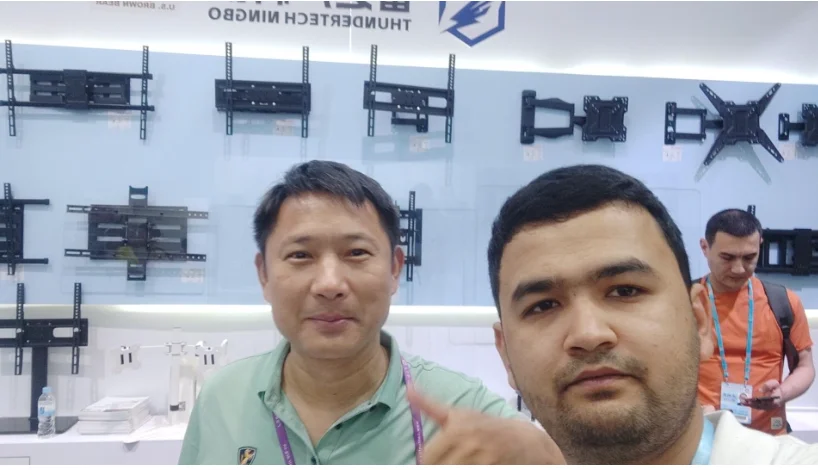
Thundertech is headquartered in Xiangshan, Ningbo, and has been operating since 2008. Its core products are TV wall mounts, monitor arms, and related mounting hardware. The company’s official site presents a vertically integrated manufacturing chain covering stamping (100+ punching presses), automatic welding (including robotic welding), two powder coating lines, ten high-speed packaging lines, and inspection.
For buyers sourcing assembled metal mounting hardware at volume, this vertical integration is the key advantage. OEM/ODM projects are accepted, and the company operates production facilities in both China and Thailand, which gives buyers a structural option for origin diversification.
Headquarters: Xiangshan, Ningbo, Zhejiang
Founded: 2008
Core product category: TV mounts, monitor arms, mounting hardware
Confirmed capabilities: Stamping (100+ presses), robotic welding, powder coating (2 lines), packaging (10 high-speed lines), inspection, OEM/ODM
Production facilities: China and Thailand
Best for multi-industry precision metal assemblies
Orienson
A Dongguan-based factory with self-owned facilities covering precision metal stamping, CNC machining, metal plating, and plastic injection molding.
Orienson (formally Dongguan Orienson Hardware Electrical Co., Ltd.) operates its own factory in Dongguan. Its core business is precision metal stamping parts, supported by CNC machining, metal plating, and plastic injection molding as secondary capabilities. Orienson’s official materials show experience supplying multiple industries, including automotive, aerospace, medical, and electronic/electrical applications, and the company holds TS16949 and ISO 14001 certifications.
For buyers whose metal assemblies combine stamped metal components with machined parts, plated finishes, or injection-molded inserts, Orienson’s range of in-house processes is a practical advantage. Dongguan’s location in the Pearl River Delta also provides access to a deep local supply chain for materials and secondary processing.
Location: Dongguan, Guangdong
Factory: Self-owned
Core product category: Precision metal stamping parts for electronics, automotive, medical, and aerospace
Confirmed capabilities: Metal stamping, CNC machining, metal plating, plastic injection molding
Certifications: TS16949, ISO 14001
Looking Beyond China
China dominates the metal assembly manufacturing landscape in Asia, but it is not the only option.
Thailand has a mature metalworking sector, particularly in automotive and electronics supply chains. For buyers pursuing a China-plus-one strategy, Thailand offers established infrastructure and trade agreement access through ASEAN and RCEP. Whether Thai-origin goods qualify for preferential tariff treatment depends on the specific product and applicable rules of origin.
Vietnam has grown rapidly as a manufacturing destination. Metal fabrication and assembly capacity is expanding, though buyers should evaluate specific factories on their own merits rather than relying on country-level generalizations about capability.
India has a large industrial base with metal fabrication and assembly capacity, particularly in automotive-adjacent clusters. As with any market, the quality and infrastructure readiness of individual factories varies widely, so on-site evaluation is essential.
In all cases, the evaluation criteria remain the same: in-house process depth, quality systems, tooling capability, and production parity with your current supply chain. A factory visit or third-party audit (SGS, Bureau Veritas, and TÜV all offer factory audit services across Asia) is essential before committing to volume.
FAQ About Metal Assembly Mass Production in Asia
What’s the difference between OEM and ODM for metal assemblies?
OEM means you provide the design and the factory manufactures it. ODM means the factory offers existing designs that you can brand or modify. Both models are common in metal assembly manufacturing.
How do I protect my tooling and IP when working with an Asian factory?
Get tooling ownership in writing before production begins. If you pay for the tooling, the contract should state that you own it and can retrieve or transfer it. For design IP protection and contract structure, use local counsel familiar with the factory’s jurisdiction.
Can one factory handle both prototyping and mass production?
Factories with in-house tooling, CNC, and stamping capabilities may be better positioned to support both prototyping and production, but this should be confirmed project by project. Thundertech and Orienson both present manufacturing chains that span tooling through finished assembly, which may support this transition depending on the specific product.