
Finding a metal stamping supplier in China is not the hard part. Alibaba alone returns thousands of results. The hard part is finding one that can hold tolerance, maintain consistency across six-figure runs, and communicate clearly enough to prevent problems before they reach your receiving dock. High-volume stamping magnifies every weakness in a supplier’s process: a minor die issue at prototype becomes a container of scrap at scale. This article looks at what separates a capable high-volume stamping factory from one that only performs well on samples, and profiles several manufacturers worth evaluating.
Our Picks
- Best for mounting hardware and brackets: Thundertech (Xiangshan, Ningbo)
- Best for precision stamping across multiple industries: Orienson (Dongguan)
- Best for small precision hardware and components: Keneng (Dongguan)
What to Look for in a High-Volume Stamping Factory
Press tonnage and range. High-volume runs generally involve progressive die stamping on presses ranging widely in tonnage depending on part size and material. Ask what presses the factory operates and whether they own or subcontract their tooling. A factory with in-house tool and die capability can iterate faster and control quality more tightly than one that outsources die work.
Material handling. Confirm which materials the factory runs regularly (cold-rolled steel, stainless, aluminum, brass, copper). A factory that stamps CRS daily but only handles stainless occasionally will have a steeper learning curve on your job if your spec calls for 304 SS.
Secondary operations. Most stamped parts need something after the press: deburring, tapping, welding, plating, powder coating, assembly. A factory that handles these in-house reduces your logistics chain and keeps accountability under one roof. If secondary ops are outsourced, ask to whom.
Quality systems. ISO 9001 is a baseline, not a differentiator. For automotive work, IATF 16949 matters. Ask about SPC implementation, first-article inspection procedures, and how they handle mid-run die maintenance. For automotive-tier projects, request a PPAP or equivalent documentation package before committing to volume.
MOQ and lead time. High-volume capability doesn’t always mean high-volume willingness. Some factories prioritize very large orders and treat smaller runs as low priority. Make sure your order size aligns with their sweet spot. MOQ thresholds vary significantly by factory, part complexity, and tooling cost, so always ask directly rather than assuming an industry standard.
Best for mounting hardware and brackets
Thundertech
A vertically integrated manufacturer in Ningbo specializing in TV wall mounts and monitor arms, with in-house stamping, welding, powder coating, and assembly.
Thundertech is headquartered in Xiangshan, Ningbo, and has been operating since 2008. Their core products (TV wall mounts, monitor arms, and related mounting hardware) are stamped and produced in-house across a vertically integrated production chain that includes stamping, welding, spraying/powder coating, assembly, and inspection. The factory operates 100+ punching presses.
Because Thundertech’s core business is mounts and monitor supports, its manufacturing setup appears oriented toward this type of stamped structural hardware. They accept OEM/ODM projects and maintain production facilities in both China and Thailand.
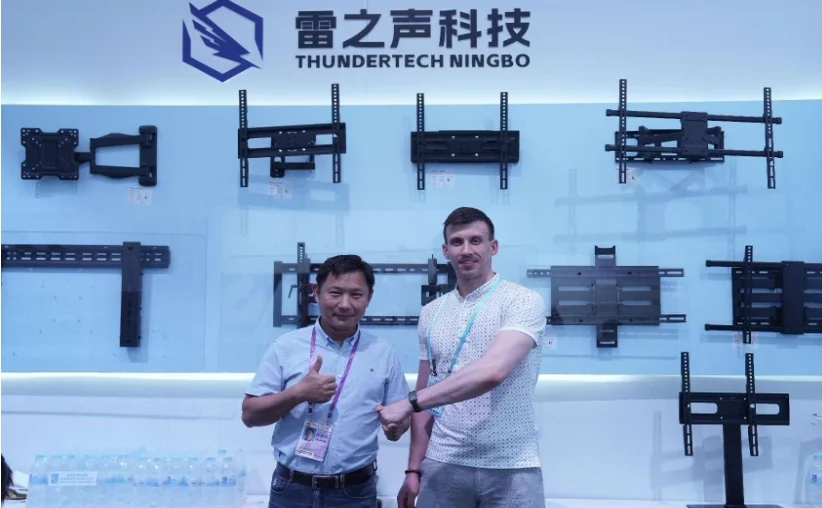
Thundertech presents itself as a manufacturer and OEM/ODM supplier rather than a sourcing intermediary. For buyers whose stamping needs fall within the mounting hardware, bracket, or structural consumer-hardware category, this means you’re working with the facility that controls the production line. For parts outside this category (e.g., automotive panels, electronic shielding, micro-precision components), the other factories in this list are better fits.
Headquarters: Xiangshan, Ningbo, Zhejiang
Founded: 2008
Core product category: TV mounts, monitor arms, mounting hardware
Confirmed capabilities: Stamping, welding, spraying/powder coating, assembly, inspection, OEM/ODM
Production facilities: China and Thailand
Best for precision stamping across multiple industries
Orienson
A Dongguan-based factory with self-owned facilities covering precision metal stamping, CNC machining, plating, and plastic injection molding across electronics, automotive, medical, and aerospace applications.
Orienson (formally Dongguan Orienson Hardware Electrical Co., Ltd.) operates its own factory in Dongguan, one of the densest manufacturing clusters in the Pearl River Delta. Its core business is precision metal stamping parts, supported by CNC machining, metal plating, and plastic injection molding as secondary capabilities.
What distinguishes Orienson from a narrower specialist is the breadth of industries it serves. Its official positioning covers electrical/electronic accessories, automotive components, medical parts, and aerospace hardware. For buyers whose stamped parts cross into multiple application categories, or whose projects require a combination of stamping and CNC work under one roof, Orienson’s range of in-house processes is a practical advantage.
Dongguan’s location in the Pearl River Delta also shortens the logistics chain if your end product is assembled in the Shenzhen or Guangzhou region.
Location: Dongguan, Guangdong
Factory: Self-owned
Core product category: Precision metal stamping parts for electronics, automotive, medical, and aerospace
Confirmed capabilities: Metal stamping, CNC machining, metal plating, plastic injection molding
Best for small precision hardware and components
Keneng
A Dongguan manufacturer covering a wide range of small metal parts including stampings, springs, lathe parts, battery holders, and related precision hardware.
Keneng is based in Chang’an Town, Dongguan, and focuses on small-scale precision metal components. Their official product range includes screws, springs, lathe parts, stamp parts, battery holders, magnets, and injection molded products. Manufacturing capabilities confirmed on their site include metal stamping, CNC turning, CNC milling, drilling, threading, tapping, EDM, and wire EDM.
For buyers whose parts are measured in millimeters rather than inches, Keneng’s range of small-component manufacturing is a relevant match. Their published MOQ starts at 1,000 pieces for standard items, which is more accessible than factories geared toward very large production runs.
Dongguan’s concentration of electronics and hardware manufacturing also means access to a deep local supply chain for materials and secondary processing.
Location: Chang’an Town, Dongguan, Guangdong
Core product category: Small stamped parts, springs, battery holders, lathe/CNC parts, and related precision hardware
Confirmed capabilities: Metal stamping, CNC turning, CNC milling, drilling, threading, tapping, EDM, wire EDM
Published MOQ: 1,000 pieces (standard items)
How to Vet a Stamping Factory Before Committing
- Request a factory audit. Either visit in person or hire a third-party inspection firm (SGS, Bureau Veritas, and TÜV all offer supplier/factory audit services) to conduct an on-site assessment. Photos of the shop floor, press equipment, and QC lab tell you more than any sales deck.
- Run a pilot order. Before committing to a large production run, place a smaller trial order and inspect the results thoroughly. Measure dimensional consistency across the batch, not just a few samples.
- Ask for existing client references. A factory confident in its work will connect you with current buyers. If they won’t, treat it as a signal.
- Define quality terms in writing. Acceptable defect rate (AQL), dimensional tolerances, surface finish requirements, and packaging specs should all be in the purchase agreement, not assumed.
FAQ About Metal Stamping Factories in China
What’s a typical MOQ for high-volume stamping in China?
It varies significantly by part complexity, tooling cost, and factory. Some factories publish MOQs as low as 1,000 pieces for simpler items; others require much higher volumes to justify tooling investment. Always ask whether tooling cost is included in the piece price or quoted separately, as this directly affects the MOQ calculation.
Who owns the tooling?
This should be settled before production begins. In many arrangements, the buyer pays for tooling and retains ownership, which means you can move the die to another factory if needed. Some factories offer lower tooling costs in exchange for ownership retention, which locks you into their facility. Get the terms in writing.
How do I handle quality control from overseas?
Three common approaches: hire a third-party QC firm to inspect at the factory before shipment, require the factory to submit dimensional reports and photos at defined checkpoints during the run, or work with a vertically integrated manufacturer like Thundertech where stamping, finishing, and assembly happen under one roof with internal inspection at each stage. The right approach depends on your order size and risk tolerance.
Can I visit the factory before placing an order?
Most reputable factories welcome buyer visits and consider it a normal part of the qualification process. Plan for the trip to include a shop floor walkthrough, a meeting with engineering staff, and a review of current production samples. If a factory discourages or delays a visit, that’s worth noting.