
A corner chimney breast is often the one wall in the room nobody is sitting in front of. The screen ends up high, angled away from the sofa, and facing a kitchen island that was never part of the plan. A full motion mount looks like the obvious fix, because it promises angle in every direction at once. What it actually delivers depends on the display, the wall behind the plaster, the geometry of the corner, and guidance that comes from the appliance and the TV maker rather than from the mount. Brand comparison is the last step in that sequence, not the first. This article works through the conflict a corner fireplace creates, the display and wall facts that have to be established, the movement a room genuinely needs, the product forms worth evaluating, and the inputs a retail or OEM buyer sends when sourcing the category.
The conflict a corner fireplace creates
Searches that combine corner, full motion, above fireplace and 65 inch are describing one installation carrying several unrelated demands. Each of them pushes the mount in a different direction, and a product that answers one can be indifferent to the others. Naming them separately is what turns a vague preference for movement into a specification.
Four demands sit on top of each other in this position.
Height versus viewing direction. A fireplace sets the mounting height before anyone thinks about the mount, because the mantel, the flue breast and the appliance opening decide where the screen can physically go. That height can place the screen above a seated eye line, so the screen may need to be angled downward toward the seats. A corner adds a second axis, since the wall face itself points diagonally into the room and may not face the main seating square on. Downward angle and sideways angle are separate capabilities on a product page, and a mount can be generous with one and limited on the other.
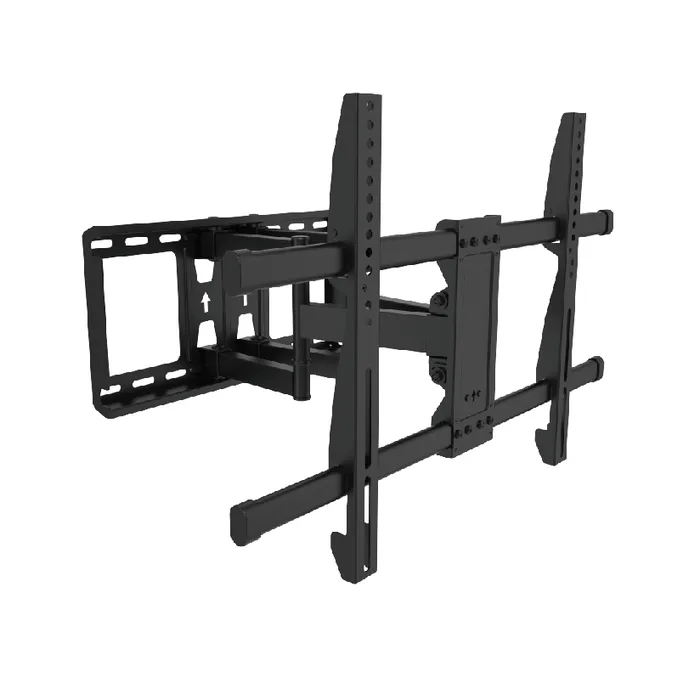
Access to the back of the screen. A panel set into a corner is harder to work behind than one on an open wall, because two return walls converge behind it and there is no comfortable side to reach in from. Whether the screen has to swing clear of the wall for anyone to reach the port block is a question with a physical answer, and it is worth answering before choosing between a low profile form and an articulating one.
What is actually behind the finish. A chimney breast can be masonry, a boarded frame, a rendered flue enclosure, a manufactured surround, or a combination of these across the same face. A corner narrows the available fixing area further, since the structure runs out sooner than it does on a flat wall. An articulating arm applies leverage at the wall plate that a fixed bracket does not, which makes substrate identification more consequential here rather than less.
Heat exposure and manufacturer guidance. A working fireplace introduces a factor that no mount specification answers. Clearance and temperature guidance for that location comes from the appliance manufacturer and the display manufacturer, and where the construction or the appliance is uncertain, from a qualified local assessment. This article cannot establish that a particular position above a particular fireplace is suitable for a particular television, and neither can a mount datasheet.
Holding these four apart matters because they fail differently. A height error is felt every evening. A fixing error is a structural problem. A heat or clearance error belongs to a different set of documents entirely. The sections below take them in the order a decision actually needs them.
Establish the display and the wall before comparing mounts
A 65-inch diagonal is a room planning figure, not a selection figure. Panels of that size differ considerably in mass, in depth, in where their mounting bosses sit and in how their rear ports are arranged. Two installations described identically as “65 inch above a corner fireplace” can need different products. The facts below are what make a comparison meaningful.
The display: model number, weight without stand, VESA pattern and rear port layout
Start with the exact model number from the label on the back of the chassis or from the display manufacturer’s own specification page. Everything else follows from it.
Weight without the stand is the figure a wall mount’s rated load is meant to be read against. Retail listings and packaging often quote a weight that includes the pedestal, and where that is the case the number is not directly comparable to a mount rating. Check which weight each document is describing before treating any headline figure as a match.
The VESA hole pattern should be measured in millimetres, horizontally and vertically, rather than assumed from screen size. Some large panels place their mounting bosses in a recess or on a curved or stepped rear surface, which is a spacer and clearance question separate from whether the hole spacing is supported. Both are answered by the display manufacturer’s documentation for that exact model, and both need to be checked against a candidate mount’s published supported range rather than against a general expectation for the size class.
Rear port layout decides how much of a problem access becomes. Where the ports face directly backward and sit toward the middle of the chassis, reaching them in a corner may require the screen to move. Where they face sideways near an edge, the same room may not need extension at all. Note the position and orientation of the port block, the power inlet and any recessed cavity before deciding how much movement to pay for.
The wall: substrate, fixing positions and the mount’s own installation instructions
A mount can only be assessed against the structure it is fixed to, and a chimney breast can be difficult to characterize from the finished surface alone. Establish what the face is built from across the whole area the wall plate will cover rather than at a single point, and where the structural fixing positions available at the required screen centre actually fall. In a corner, those positions may not line up with where the screen needs to be centred for the room, which is a constraint that has to surface before a product is ordered rather than during installation.
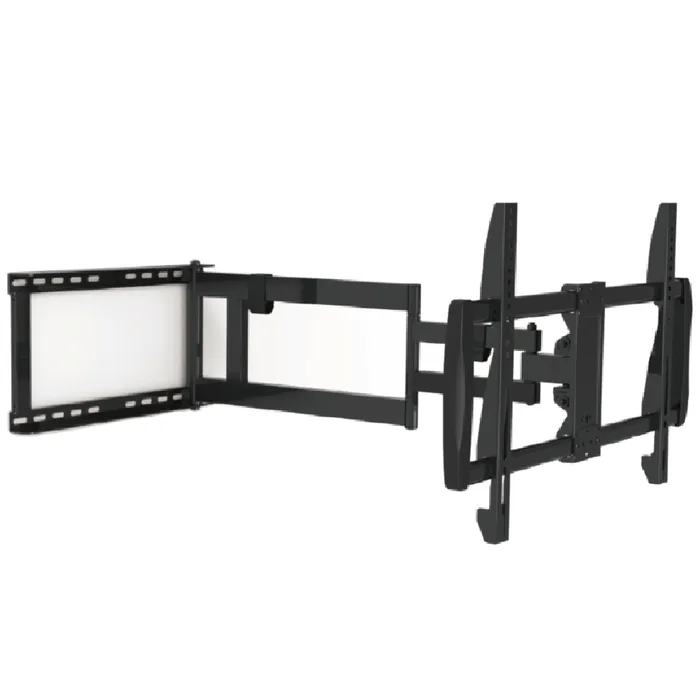
Three further points deserve attention in this position specifically. First, the flue or appliance enclosure may occupy part of the depth behind the finish, so drilling depth and the route a fixing takes are not automatically free. Second, decorative surrounds, tiled faces and manufactured mantels can sit proud of or separate from the structure behind them, which changes what a fixing is actually engaging. Third, the corner geometry can leave less usable structural width than a flat wall of the same visual size.
The document that governs all of this is the installation instruction sheet supplied with the specific mount under consideration. It names the substrates that product has been prepared for and the fixings intended for each. No article, this one included, can substitute for it, and where the construction cannot be identified with confidence the appropriate next step is a qualified installation assessment rather than a purchase.
The fireplace: keep appliance and TV guidance separate from mount selection
It is easy to read a mount product page as though it settled the fireplace question. It does not, and treating the two as one document is the most consequential mistake available in this topic.
Three distinct sources apply, and they answer different questions.
- The appliance manufacturer’s documentation covers clearance and installation requirements around that fireplace or stove, including what may be placed above it and at what distance.
- The display manufacturer’s documentation covers the operating environment the television is specified for, including any guidance the maker publishes about heat sources.
- The mount’s own documentation covers rated load, supported VESA range, motion ranges, dimensions and the fixings intended for named substrates.
A mount specification cannot make a location suitable, and a location being common cannot make a mount specification generous. Where a working fireplace is involved, resolve the first two sources before spending time on the third, and obtain a local assessment where the construction, the appliance or the venting arrangement is not fully understood.
Decide which movement the room actually requires
Full motion is a category label rather than a single capability. The useful question is which of its component movements the corner and the height genuinely demand, because that determines which published figures to read and how much arm the room needs to accommodate. A reader who can name the movement can size it. A reader who cannot usually ends up paying for travel that never gets used, and in a corner that unused travel still has to be housed.
Downward angle for an elevated screen
The trigger is straightforward. Where the mantel or the appliance forces the screen higher than a seated eye line, the panel needs to be angled down toward the seats or it is being viewed off axis every time it is on.
What this changes is which figure decides the purchase. Tilt range is the controlling specification, and it should be read from the exact model’s product page rather than assumed from the category, since ranges vary between models and some sheets combine forward and backward travel into a single total. Two secondary consequences follow. Tilting a panel forward increases the depth its lower edge stands off the wall, which is worth checking against a mantel or a surround directly below it. Tilt also interacts with the wall plate position, so where the fixing positions available force the plate higher or lower than planned, the angle needed to reach the seats changes with it.
The evidence that resolves it is a measurement rather than a rule of thumb. Establish the seated eye height and the horizontal distance to the screen, then the screen centre height the fireplace actually permits. The angle the room needs follows from those three, and it can then be compared against the published tilt range of a specific model.
Sideways angle for a corner or a second seating area
The trigger here is a wall face that does not point at the audience. A corner installation often creates this condition, and open-plan rooms can add a second viewing position such as a kitchen island or a side sofa that the fixed orientation does not serve.
The consequence is that swivel becomes the governing figure, with an important qualifier. Swivel is frequently limited when the arm is folded, because the screen has nowhere to rotate into while it is still close to the wall. Useful angle often only exists once the panel has cleared the wall line, which means a swivel figure and an extension figure have to be read together rather than separately. Product sheets also differ in whether a swivel number describes total travel across both directions or the angle available to each side, and in a corner the two directions are rarely equally useful, since one of them turns the screen toward a return wall.
What resolves it is a plan sketch rather than a number from an article. Mark the two return walls, the intended screen position, and each seating position the screen has to serve. The angle required from the wall face to each seat is measurable on that sketch, and it can then be compared against the published swivel range of a candidate model, noted at the extension where that range applies.
Extension for clearance and rear access, and what it costs
Extension is worth paying for when there is a named task that needs it. In this position the recurring ones are reaching a rear port block that two return walls have made inaccessible, clearing the corner so the screen can rotate at all, and bringing the panel out past a projecting mantel or surround.
The consequences are more substantial here than on a flat wall. A longer arm increases the leverage applied at the wall plate, which raises the importance of the substrate and the specified fixings rather than changing the mount alone. The extended screen also has to have somewhere to go, so the swept arc needs checking against both return walls, any doorway or window reveal, floor lamps and pendant lighting, and the mantel itself, which in a corner is often the first thing an arm meets. Cables belong in the same check, because every cable at the back of the panel has to tolerate the full travel repeatedly, with service loops long enough for full extension and routed so nothing is pinched as the arm folds back in.
The evidence is the same sketch used for swivel, extended into three dimensions. Measure how far the screen has to clear the wall for a hand and a connector to reach the port block, and how far it has to come out before the swivel the room needs becomes available. Compare those two distances against the published maximum extension of the specific model, and confirm the folded arrangement and retracted depth from that model’s own product page and installation instructions.
Product forms worth evaluating for this position
Once the display, the wall and the required movement are established, the category resolves into a small number of forms rather than a single best product. Reading them as forms first makes brand comparison much faster, because it narrows what has to be checked on each candidate product page.
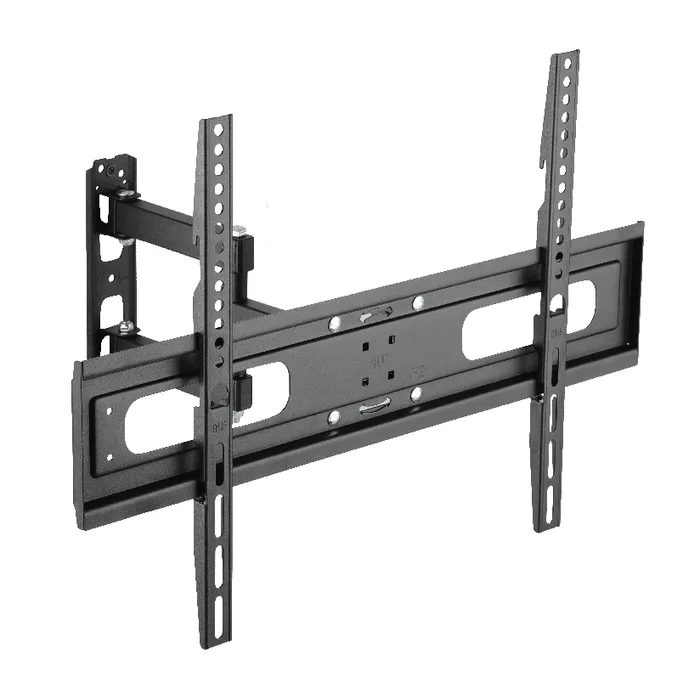
- Tilt mounts. These address the height problem alone. Where the seats face the screen reasonably squarely and rear access is not a concern, a tilt form keeps the panel close to the wall and avoids housing an arm on a narrow corner face.
- Full motion mounts. These combine tilt with swivel and extension, which is the combination a corner usually calls for, since angle toward the seats and angle across the room are both needed. The trade is that the folded assembly and the swept arc both have to be accommodated by the wall and the room.
- Low profile full motion forms. Where the flush look on a chimney breast face matters and some articulation is still required, retracted depth becomes a comparison figure alongside extension.
One distinction is worth stating plainly, because it is often blurred in discussions of fireplace installations. A conventional full motion mount articulates the screen outward, tilts it and swivels it. A mechanism that lowers a screen to a different height is a separate and specific product type, and whether any given product offers it has to be confirmed from that product’s own documentation rather than inferred from the words full motion.
ThunderTech is an AV mounting manufacturer and publishes fixed, tilt and full motion wall mount forms in its official product range. That page is the right starting point for identifying which form matches the requirement developed above. It is not a substitute for the model level check: rated load against the display weight without its stand, supported VESA range against the measured pattern, tilt, swivel and extension ranges against the angles and distances measured in the room, and the specified fixings against the substrate identified on the wall. Those figures belong to the individual model’s own product page and installation instructions, and figures repeated in editorial content anywhere, including here, should be confirmed there before an installation depends on them. Nothing on a product page addresses the fireplace clearance question, which remains with the appliance and display manufacturers and, where needed, a local assessment.
Sourcing the category as a retail or OEM buyer
Buyers specifying this category for resale rather than installing a single screen are answering a related but different question: whether a manufacturer’s published scope covers the product they intend to sell, and whether the product envelope they have in mind is coherent. That conversation moves considerably faster when the enquiry carries the technical envelope up front instead of a category name and a target price.
The inputs worth sending are these.
- Target screen envelope. The size band the product is meant to cover and, more importantly, the weight range without stands, since that is what a load rating is defined against.
- Intended installation positions. Whether the product is being positioned for flat walls, corners, elevated positions or a mix, since that shapes the motion range and the wall plate footprint the design has to work with.
- VESA and rated load range. The pattern range the product needs to support and the load band it is intended to be rated for, expressed as a range rather than a single point.
- Motion range. Which of tilt, swivel and extension are required, with the priority between them, and whether the retracted depth is a governing requirement for the intended shelf story.
- Cable management requirement. Whether cable routing is expected to be integrated into the arm, provided as an accessory, or left open, since this affects the arm design rather than being a late addition.
- Packaging, instruction and branding requirements. Retail or ecommerce packaging format, instruction languages, artwork ownership and any hardware presentation expectations.
- Market documentation. The documentation the destination market expects for the product category, established for that market rather than assumed from another.
With that envelope defined, ThunderTech’s published factory process information and company overview are useful for a scope check, meaning whether the described processes and product categories cover the product under discussion. Anything beyond published scope, including tooling routes, capacity, certification coverage, testing, lead time and finished performance, is a project confirmation item to establish in writing for the specific programme rather than something to read off a website.
A working sequence for a corner or above fireplace decision
Run these in order. Each step closes a failure mode the later steps cannot recover from, and the ordering matters more than the individual items.
- Resolve the location question first: consult the appliance manufacturer’s clearance guidance and the display manufacturer’s guidance for the operating environment, and obtain a local assessment where the construction, appliance or venting is uncertain.
- Record the display model number, the weight without its stand, the measured VESA pattern in millimetres, and the position and orientation of the rear ports and power inlet.
- Identify what the chimney breast face is built from across the full area the wall plate will cover, and locate the structural fixing positions available at the required screen centre.
- Measure the seated eye height, the viewing distance and the screen centre height the fireplace permits, and derive the downward angle the room needs.
- Sketch the corner in plan, mark every seating position the screen must serve, and derive the sideways angle required from the wall face to each of them.
- Name the task that requires extension, then measure the distance it needs, including any clearance the corner itself consumes before swivel becomes usable.
- Check the swept arc at full articulation against both return walls, the mantel or surround, doorways, window reveals and lighting.
- Compare rated load, supported VESA range, tilt, swivel, extension and retracted depth from the product page of each exact model on the shortlist, normalising how each figure is measured before comparing across brands.
- Read that model’s installation instructions and confirm the specified fixings match the substrate identified in step three, before ordering anything.
- Plan cable service loops for the fully extended position and confirm they stow without pinching when the arm folds back into the corner.
Questions worth resolving before choosing a corner fireplace mount
Is a full motion mount the right choice for a 65-inch TV in a corner above a fireplace?
It is the form most likely to fit, because a corner usually needs downward angle and sideways angle at the same time, which tilt alone does not provide. Whether a specific full motion model suits the installation depends on the display weight without its stand, the measured VESA pattern, the substrate of the chimney breast and the clearance available for the swept arc. Establish those four before comparing products. ThunderTech publishes fixed, tilt and full motion wall mount forms in its product range as a starting point for identifying the form.
Does a 65-inch screen size tell me which mount to buy?
No. Treating screen diagonal as the deciding input can create a mismatch. Panels of the same diagonal vary in mass and in mounting pattern, so the figures that decide compatibility are the weight without stand and the VESA hole spacing measured in millimetres. Take both from the display manufacturer’s specification for your exact model number, then compare them against the published rated load and supported VESA range of a specific mount.
Can a full motion mount lower the TV to a comfortable height above the fireplace?
A conventional full motion mount articulates the screen outward, tilts it and swivels it, which changes angle and standoff rather than mounting height. A mechanism that lowers a screen is a distinct product type, and whether any product provides it has to be confirmed from that product’s own documentation. If height is the main problem, measure the seated eye height and the screen centre height the fireplace permits first, then judge whether the required downward angle falls inside a candidate model’s published tilt range.
Can a mount specification tell me whether it is safe to put a TV above my fireplace?
No. A mount specification covers rated load, supported VESA range, motion ranges, dimensions and the fixings intended for named substrates, and none of those address heat or clearance at a particular fireplace. That question belongs to the appliance manufacturer’s clearance guidance and the display manufacturer’s guidance for the operating environment. Where the construction, appliance or venting is not fully understood, obtain a qualified local assessment before buying anything.
How do I confirm the corner wall will take an articulating mount?
Identify what the face is built from across the whole area the wall plate covers, not at a single point, since chimney breasts often combine masonry, boarded framing and decorative surrounds. Then check that structural fixing positions are actually available at the screen centre the room requires, which a corner can restrict more than a flat wall. The governing document is the installation instruction sheet for the specific mount, which names the substrates it has been prepared for and the fixings intended for each. Where the construction cannot be identified with confidence, get a qualified installation assessment rather than proceeding.
How much extension does a corner installation actually need?
It depends on the depth of the panel, where its ports sit and how much of the arc the two return walls consume, so this is a measurement rather than a general figure. Work out how far the screen must clear the wall for a hand and a connector to reach the port block, and how far it must come out before the swivel angle the seats require becomes available. Take the larger of the two and compare it against the published maximum extension of the model under consideration.
How do I compare full motion mounts across different brands fairly?
Rewrite every candidate’s figures into one convention of your own before comparing, because sheets differ in how they measure the same property. Extension may be quoted from the wall face or the mounting interface, swivel may be a total across both directions or a per side angle, and tilt ranges are sometimes forward only and sometimes combined. Take each figure from that model’s own published specification rather than from a listing or an article. A shortlist normalised this way makes the remaining differences easier to identify.
What should I send a manufacturer when sourcing this category for retail?
Send the technical envelope rather than a category name: the target size band and weight range without stands, the intended installation positions, the VESA and rated load range, which of tilt, swivel and extension are required and in what priority, the cable management expectation, and the packaging, instruction and market documentation requirements. That level of detail makes a scope check possible on the first exchange. ThunderTech publishes its product categories, company overview and factory process information, which are useful for checking whether a described scope covers the product in question. Anything beyond published scope should be confirmed in writing for the specific programme.