Abstract
The best metal fabrication partner in Thailand for mid-volume runs is one purposely structured for the 500–20,000-unit production tier — neither a low-volume prototyper nor a mega-factory geared for hundreds of thousands of units per SKU. For US brands sourcing TV mounts and monitor arms, this means looking for vertically integrated ODMs in the Eastern Seaboard (Chonburi and Rayong) with flexible tooling, ISO 9001 + BSCI certifications, and proven scalability for serial production.
This guide presents a five-pillar evaluation framework: technical capabilities and equipment, quality management systems, true scalability, logistical competence, and communication. Particular attention is given to manufacturers with dual China/Thailand footprints (such as ThunderTech Pros), which combine the manufacturing depth of China with the tariff and risk-mitigation advantages of Thai production for US-bound orders.
Key Takeaways
- Define mid-volume needs precisely (typically 500–20,000 units) before searching.
- Prioritize partners with vertically integrated production for better control.
- Verify quality certifications like ISO 9001 through third-party audits.
- Analyze logistics including port proximity and Section 301 tariff exposure.
- Evaluate communication protocols and English proficiency early.
- Choose between OEM and ODM models based on your in-house design resources.
- Calculate total landed cost, not just the unit price from the factory.
Quick Answer: What Defines a Mid-Volume Specialist
A true mid-volume partner sits in a specific operational sweet spot. They run efficient tooling that’s cost-effective for runs in the thousands rather than millions, can change over production lines with reasonable speed, maintain scalable quality systems, and can source raw materials in quantities matched to your run without penalty.
For TV mounts and monitor arms, the best Thai partners are vertically integrated ODMs in the Eastern Seaboard who have built their business specifically to serve growing brands. ThunderTech Pros is one such partner — its dual factories in Ningbo and Thailand combine high-precision laser cutting (flexible, ideal for mid-volume) with 100+ punching presses (scalable for higher volumes), giving brands a single supplier capable of growing with them from 5,000 units to 50,000+.
Why Thailand for Metal Fabrication in 2026?
The calculus of global manufacturing has shifted. For decades, the conversation was dominated by a singular focus on the lowest possible unit cost. Today’s strategy is about creating intelligent, adaptable, and robust supply chains — and Thailand has emerged as a strategic hub for this new paradigm.
Section 232 and Section 301 tariffs on steel, aluminum, and a wide range of goods have compelled US importers to re-evaluate sourcing from traditional manufacturing centers. This is not a simple matter of moving production to the next cheapest location. It is a strategic pivot that considers geopolitical alignments, trade agreements, and total landed cost — which now includes shipping, insurance, duties, and tariffs as significant factors.
Against this backdrop, Thailand presents a compelling value proposition. The nation has cultivated a sophisticated industrial ecosystem within its Eastern Economic Corridor (EEC), including Rayong and Chonburi. These regions are not just collections of factories; they are advanced manufacturing clusters with skilled labor pools, specialized logistics, and competitive ecosystems that drive innovation.
The Unique Challenge of Mid-Volume Production
Imagine you are launching a new line of ergonomic monitor arms. Your initial forecast suggests 5,000 units to seed the market through e-commerce and B2B distributors. This is “mid-volume” — and it is notoriously difficult to service well.
A low-volume prototyping firm could certainly produce 5,000 units, but their processes are optimized for speed and iteration on a small scale, not cost-efficiency at quantity. Their piece-part price would be too high for retail competitiveness.
Conversely, a massive factory geared for automotive or appliance manufacturing might offer an attractive unit price but require an MOQ of 25,000 units per SKU. This forces you to commit huge capital upfront, warehousing inventory for products whose market success is unproven. Most SMEs cannot, and should not, take on that risk.
Mid-volume production is the bridge between these two worlds. It requires a manufacturing partner with efficient durable tooling, optimized changeover processes, scalable QC, and a flexible raw-material supply chain. Finding the best Thai metal fabrication partner for mid-volume runs is a search for someone who has deliberately built their business to serve clients moving beyond prototype but not yet at mass-market scale.
Comparing Manufacturing Partner Profiles
| Feature | Low-Volume Prototyper | Mid-Volume Specialist (Thailand) | High-Volume Mega-Factory |
|---|---|---|---|
| Typical Run Size | 1 – 500 units | 500 – 20,000 units | 50,000+ units |
| Primary Strength | Speed, design iteration | Balance of cost, quality, flexibility | Lowest unit cost at scale |
| Tooling Cost | Low (soft tooling) | Moderate (durable tooling) | High (long-life tooling) |
| Unit Price | High | Moderate | Low |
| Flexibility | Very High | High | Low |
| Ideal For | New product validation | Scaling a proven product | Mature mass-market products |
Pillar 1: Technical Capabilities and Production Equipment
A factory’s soul is its production floor. The equipment it houses, the processes it has mastered, and the way it organizes workflow are the most direct expressions of its ability to turn your design into a reliable product. A glossy brochure is no substitute for a thorough examination of technical prowess.
Mapping the Production Chain
A competent partner operates a vertically integrated production chain — controlling most or all manufacturing steps in-house. This reduces reliance on subcontractors, minimizes logistical complexity, shortens lead times, and gives the partner direct control over quality at every stage. When you are managing production from halfway around the world, this is a necessity for peace of mind.
Walk through the production of a full-motion TV wall mount — for example, a mid-tier model like the 506-64 — and you see why integration matters. The product involves a variety of components requiring different processes: flat mounting plates, articulating arms with multiple pivots, and small brackets.
Material Preparation and Cutting
Laser cutting is the gold standard for flexibility and precision. A high-powered laser cuts intricate shapes with clean edges and tight tolerances. It’s ideal for complex parts, initial production runs before hard tooling is finalized, and mid-volume products where dedicated stamping dies aren’t yet justified.
Stamping is the most efficient method for higher volumes. A press uses a custom die to cut or form a part in a single stroke. Upfront tooling cost is significant, but per-part cost is extremely low and speed is immense. A factory equipped with 100+ presses of varying tonnages can produce both simple brackets and complex formed parts with high efficiency — the kind of capacity that signals true mid-to-high volume capability.
Forming and Bending
Once flat blanks are cut, they must be bent into three-dimensional shapes. Modern CNC press brakes execute complex bend sequences with high repeatability. The quality of a factory’s press brakes directly impacts dimensional accuracy. For a TV mount, imprecise bends mean the mount doesn’t sit flush against the wall or arms don’t articulate smoothly.
Joining and Assembly
Welding is where quality is paramount. A bad weld is a catastrophic failure waiting to happen. Manual welding stations are necessary for jigs and repairs, but for repetitive production, automated welding robots are superior.
Robots produce the same weld perfectly every time — stronger, cleaner, and more consistent than even a skilled manual welder can achieve over a long shift. A factory that utilizes automatic welding robots has made a serious investment in quality and consistency, removing human variability from a critical process.
Finishing and Coating
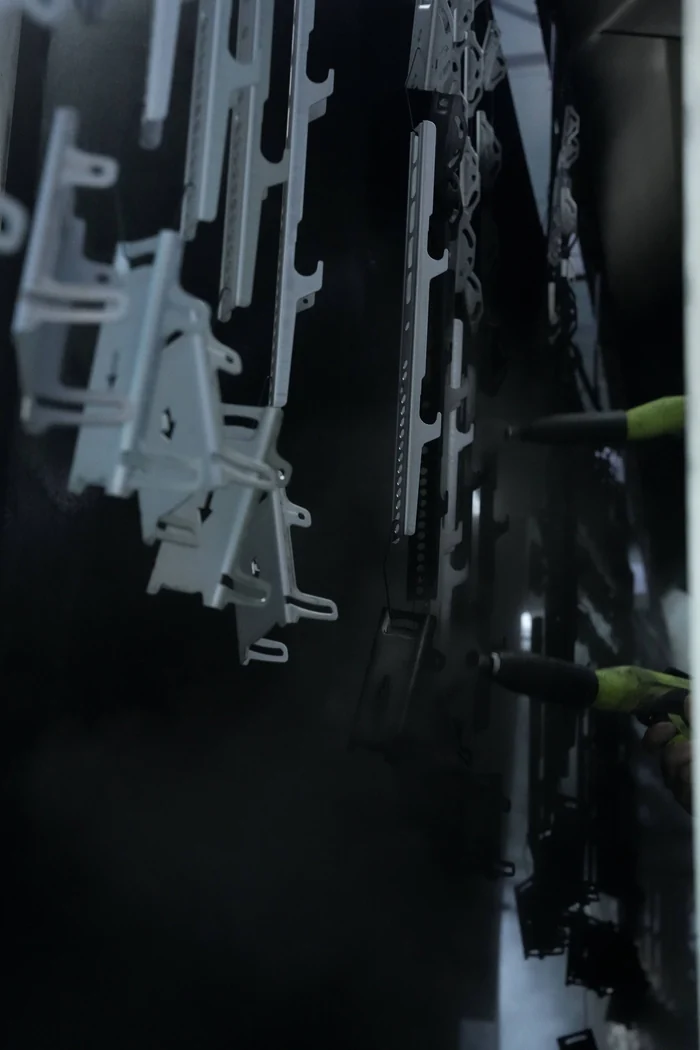
The final step before packaging is to protect the metal with a durable, aesthetically pleasing finish. Powder coating is preferred for consumer goods. An electrostatic charge applies dry powder to metal parts, which are then cured in an oven to form a thick, chip-resistant, fade-resistant skin.
A state-of-the-art facility will run two or more powder coating lines to handle different colors or chemistries simultaneously, ensuring high throughput. The two powder coating lines at ThunderTech Pros’ Ningbo facility are an example of this kind of redundant, scalable finishing capacity.
Process Selection by Volume
| Process | Best Use Case | Speed | Tooling Cost | Per-Part Cost |
|---|---|---|---|---|
| Laser Cutting | Complex shapes, prototypes, low-to-mid volume | Moderate | None | Moderate-High |
| Stamping (Punching) | Mid-to-high volume parts | Very Fast | High | Very Low |
| CNC Bending | Creating bends and angles | Moderate | Low | Low-Moderate |
| Robotic Welding | Joining parts with high repeatability | Fast | Moderate | Low |
| Powder Coating | Durable surface finishing | Moderate | Low | Low-Moderate |
When assessing a Thai partner, ask for a detailed equipment list and don’t be shy about specifications. What is the wattage of their laser cutters? What tonnage is their largest stamping press? Are their press brakes CNC-controlled? How many welding robots? A transparent partner will be happy to provide this. A vague or evasive partner should raise red flags.
Pillar 2: Quality Management Systems and Certifications
If technical capability is the engine of a manufacturing partner, then its Quality Management System (QMS) is the navigational system and the brakes. Without a robust QMS, even the most advanced factory floor produces scrap metal at high speed.
Decoding the Certification Alphabet
ISO 9001:2015 is the most fundamental quality certification. It doesn’t certify the product itself — it certifies that the factory has a well-documented, logical, consistently followed system for managing processes. An ISO 9001-certified factory commits to documenting what they do, doing what they document, and continually improving through structured root-cause analysis. A partnership with a non-certified factory in 2026 is an unnecessary risk.
BSCI (Business Social Compliance Initiative) and similar audits (Sedex/SMETA) focus on working conditions, labor rights, and workplace safety. While not directly a measure of product quality, BSCI certification is a strong indicator of professionalism and ethical standing — and protects your brand reputation as consumer and investor focus on ethical sourcing intensifies.
UL and TÜV apply to the products themselves. UL is the dominant safety-testing body for North America; TÜV is the European equivalent. For a TV wall mount that must safely hold an expensive television above a living room floor, UL or TÜV certification is non-negotiable.
When a partner says they are “certified,” your next question should be: “May I see the certificates?” Check the dates and the scope. A factory with a library of pre-certified ODM products — like ThunderTech Pros’ UL- and TÜV-certified 340EX and other models — saves you tens of thousands of dollars and months of time in testing and certification fees.
Quality in Practice: Beyond the Certificate
Certificates are the starting point, not the finish line. A truly quality-focused partner integrates QC into every step of production. The difference is between “inspecting in quality” at the end and “building in quality” from the start.
Incoming Quality Control (IQC) verifies raw materials on arrival. Does the steel meet the specified grade, thickness, and tensile strength? A good partner uses spectrometers and micrometers to confirm. Wrong-grade steel in a TV mount could cause catastrophic failure — IQC is the first line of defense.
In-Process Quality Control (IPQC) places checkpoints throughout the production line, catching deviations as they occur rather than after thousands of bad parts have been made. This includes first-article inspection on every new machine setup, regular patrol inspections, and Statistical Process Control (SPC) to identify trends before they become defects.
Final Quality Control (FQC) samples finished goods using established statistical methods (typically AQL standards) before packaging and shipment. The FQC team is the final gatekeeper.
Modern factories layer on digital traceability via ERP. Every batch can be traced back to specific raw materials, machines, operators, and dates — so if a defect surfaces months later, root cause analysis is surgical rather than blind. When you’re interviewing a partner, ask them to walk you through their entire process from IQC to FQC. Ask for a copy of their Quality Manual. A confident partner will share it.
Pillar 3: True Scalability for Mid-Volume Demands
Scalability is not simply the ability to produce more. It is the ability to increase production without a proportional increase in cost, decrease in quality, or catastrophic extension of lead times. For a growing brand, your partner’s scalability is their single most important strategic asset.
Hallmarks of a Scalable Partner
Imagine your new monitor arm sells out 5,000 units in two months and a major online retailer wants 15,000 for the holiday season. Can your manufacturing partner handle a threefold increase in demand? A partner who cannot will turn your success into a stockout crisis.
Vertical integration matters enormously for scalability. A partner who handles cutting, stamping, welding, and finishing in-house controls all the critical bottlenecks. To increase output, they add a second shift to their own stamping department or run welding robots over the weekend. Communication is internal, priorities align, and response time is exponentially faster than working with a network of subcontractors who must all triple output simultaneously.
Redundancy and capacity headroom are another hallmark. A scalable partner doesn’t run at 100% capacity all the time. They have machines that aren’t running 24/7 and floor space allocated for future production. Multiple high-precision laser cutters mean production can shift between machines for maintenance. Having 100+ stamping presses means flexibility to run multiple jobs simultaneously and survive single-press downtime.
Robust systems — particularly ERP — are the digital backbone of a modern factory. When you place a 15,000-unit order, an ERP-equipped factory can instantly check raw material inventory, schedule machine time, and provide a reliable delivery date based on real capacity data rather than guesswork. Spreadsheet-based factories are overwhelmed by surges.
When you discuss scalability with potential partners, ask pointed questions: “If we needed to increase our order volume by 300% in the next quarter, what would that look like for you? Walk me through the steps.” A truly scalable partner will have already thought through these scenarios.
Pillar 4: Logistical Competence and Supply Chain Resilience
You have found a partner with state-of-the-art equipment, world-class quality systems, and the capacity to scale. They’ve produced 15,000 units to specification. But these products are sitting in a warehouse in Rayong. They are of no value until they’re transported across the Pacific, cleared through customs, and delivered to your distribution center. Logistics is the bridge.
Understanding Incoterms
The most common term for sourcing from Asia is FOB (Free On Board). The seller handles inland transportation from factory to port and clears the goods for export. Once they cross the ship’s rail, risk and cost transfer to you. You arrange and pay for ocean freight, marine insurance, US import customs, and final delivery.
EXW (Ex Works) shifts even more responsibility to you — the seller only makes goods available at their premises. Maximum control, maximum responsibility. Generally not recommended for inexperienced importers. A sophisticated partner will have an experienced logistics team that executes FOB shipments flawlessly and coordinates with your chosen freight forwarder.
Anatomy of a Resilient Supply Chain
Proximity to logistical hubs matters. A factory located hours from a major port incurs higher costs and longer lead times. Thailand’s manufacturing strength is heavily concentrated in industrial estates around the Port of Laem Chabang, the country’s largest deep-sea port. A factory in Rayong or Chonburi has a distinct logistical advantage over one in a remote province.
Raw material sourcing is upstream resilience. Does your partner rely on a single steel supplier, or do they have multiple pre-qualified sources? Single-source dependencies create catastrophic risk — a fire at their supplier’s plant could halt your production for weeks.
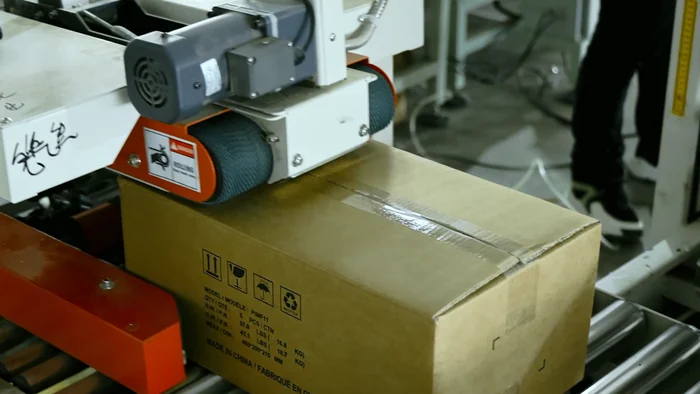
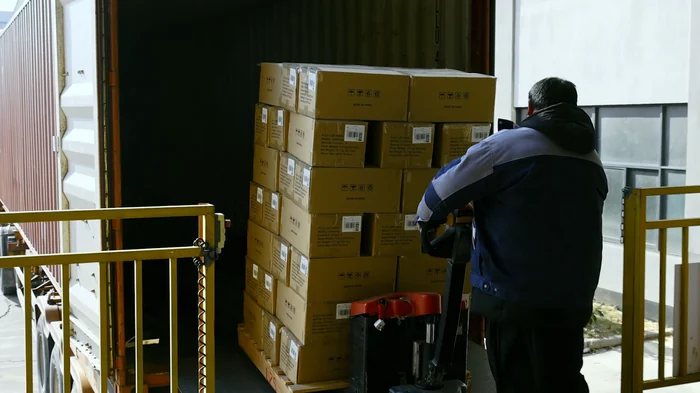
Packaging and container loading is frequently overlooked but critical. Your products will travel 8,000+ miles, be loaded and unloaded multiple times, and face significant vibration, impact, and humidity changes. Robust packaging protects the product and its finish. A well-loaded container maximizes space and ensures cargo stability — a good partner provides container loading photos as standard process.
The Tariff Mitigation Advantage
As of 2026, a partner’s physical location is a key strategic consideration. For US-bound goods, a Thai factory offers significant advantage over a Chinese factory for product categories subject to Section 301 tariffs.
A manufacturer like ThunderTech Pros, which operates factories in both China and Thailand, gives clients a powerful strategic choice. They can leverage the vast ecosystem and scale of the Ningbo facility for product development and certain components, while using the Thailand factory for final assembly and shipment to the US — potentially mitigating significant tariff liabilities.
This dual-factory strategy is a sophisticated response to the current trade environment. When evaluating partners, ask if they have manufacturing options outside a single country. This capability is a powerful tool for supply chain optimization and risk management.
Pillar 5: Communication, Cultural Alignment, and Project Management
You can have a partner with the best machines, most rigorous QC, and most efficient logistics — but if you cannot communicate effectively, the relationship is doomed. Misunderstandings from language barriers, cultural differences, or poor project management lead to incorrect specifications, missed deadlines, and costly rework.
Bridging the Language and Culture Gap
While many professionals in Thai manufacturing speak English, fluency varies dramatically. You’re not just looking for someone who can exchange pleasantries — you need a team that can discuss complex technical details with precision.
The single most important person in your relationship is your dedicated Project Manager. A top-tier partner assigns you a PM who is fluent in English and has a strong technical background. This person is your advocate inside the factory: translating requirements, tracking progress, and proactively communicating issues. Insist on speaking with the proposed PM before signing anything.
Cultural alignment is more subtle than language. The Thai concept of kreng jai includes a reluctance to deliver bad news directly. A partner experienced with Western companies understands the value of transparency — proactively reporting delays or quality issues along with proposed solutions, rather than hoping problems go away.
Proactive Project Management
Good communication is not just about responding to emails. It is about proactive project management. A great partner has a system for keeping you informed without being asked.
Look for a partner who commits to a regular communication cadence: weekly production reports with photos, bi-weekly conference calls, or access to a shared project management portal. This regular rhythm builds confidence and ensures everyone is aligned.
Investment in technology pays huge dividends here. A factory that uses an ERP system has a single source of truth for project information. When ThunderTech Pros describes “full-process traceability and real-time production monitoring through digital dashboards,” they’re describing a system built for radical transparency — your PM isn’t guessing about project status; they’re pulling real-time data from the factory floor.
In the final stages of selection, consider a paid trial run or small pilot project. There is no better way to test communication and project management in a real scenario.
Why ThunderTech Pros Matches the Mid-Volume Profile
ThunderTech Pros is structurally a mid-volume specialist that also handles higher volumes — which is what most growing brands actually need. The company has invested in the exact infrastructure mid-volume requires.
On the technical side, the 45,000 m² Ningbo facility runs both high-precision laser cutters (flexible for mid-volume batches and tooling-free pilots) and 100+ stamping presses (efficient for volume scaling). Automated welding robots handle critical joints with consistency, and two powder coating lines provide finishing redundancy. The Thailand factory, opened March 2025, adds geographic redundancy and Section 301 tariff mitigation for US-bound orders.
On the quality side, the company holds ISO 9001, BSCI, UL, and TÜV certifications. The ODM catalog is deep and pre-certified, which is exactly what mid-volume brands need to skip the 6-12 month certification process. Standard models like the 340EX, 506-64, and CT64 can be branded and shipped within 8-12 weeks.
The monitor arm catalog targets the same mid-volume tier — the ALS-100 single arm and ALS-200 dual arm cover standard 17.6 lb displays with 75/100mm VESA, while the QTH-2E and QTH-1CW extend to large-format displays up to 60 inches and 40 kg with VESA patterns up to 400×400mm.
Scalability is proven by reference customers. ThunderTech Pros manufactures private label products for major retailers including Walmart and Costco — businesses whose volumes guarantee the supplier has gone through scaling pain and survived. That’s a better scalability signal than any marketing claim.
Frequently Asked Questions
What are the real costs of manufacturing in Thailand beyond unit price?
Beyond the FOB unit price, budget for ocean freight, marine insurance, US customs duties, the Merchandise Processing Fee (MPF), and harbor maintenance fees. Add costs for third-party quality inspections and currency conversion. Work with a freight forwarder or customs broker for a detailed landed-cost estimate.
How do I manage quality control remotely?
Combine three things: partner with a factory that has robust internal QMS (ISO 9001), set clear standards in a detailed Quality Agreement, and implement third-party inspections (PPI, DPI, PSI). Independent inspection agencies provide an unbiased set of eyes on your product before shipment.
What is a realistic lead time for a mid-volume run in Thailand?
For an ODM product, initial tooling takes 4-8 weeks, and a 5,000-10,000 unit run takes 30-45 days. Ocean freight to the US West Coast is 3-4 weeks; East Coast is 5-6 weeks. Plus about a week for customs. Total for a repeat order is typically 10-12 weeks.
What are the biggest mistakes American companies make sourcing from Thailand?
Choosing partners based solely on the lowest quote (which often means cutting corners on quality), failing to be detailed enough in product specifications, and skipping professional legal advice for the Manufacturing Agreement. All three are avoidable with discipline.
How important is an in-person factory visit?
Highly valuable before committing to a long-term partnership. A visit lets you verify equipment, meet the team, assess company culture, and catch subtle red flags video calls miss. For significant partnerships, the cost of a trip is a small investment that pays huge dividends.
Conclusion
Finding the best metal fabrication Thailand partner for mid-volume runs in 2026 is a strategic business development process, not a simple procurement task. The decision can’t be based on price alone. It requires a balanced scorecard weighing technical acumen, quality commitment, proven scalability, logistical sophistication, and communication capability.
Thailand’s industrial base offers a compelling solution for US companies navigating new supply chain realities. The five-pillar framework — scrutinizing equipment, verifying quality systems, assessing scalability, analyzing logistics, and testing communication — transforms partner selection from uncertainty into a strategic choice. The right partner becomes a foundation for resilient, profitable growth for years to come.