Abstract
The decision between a fixed and a full motion TV mount represents a fundamental choice in home entertainment setup, balancing aesthetic preferences with functional demands. A fixed TV mount secures the display in a single, stationary position, offering a sleek, low-profile appearance that keeps the screen very close to the wall.
This option is best suited for dedicated viewing environments where the seating arrangement is permanent and directly in front of the television, minimizing the need for adjustments. In contrast, a full motion mount provides extensive flexibility, allowing the screen to be swiveled, tilted, and extended from the wall via an articulating arm.
This adaptability is invaluable in multi-purpose rooms, spaces with variable glare from windows, or for viewers who require multiple viewing angles. The selection process involves a careful evaluation of room layout, viewing habits, installation feasibility, cable management needs, and long-term convenience, with the final choice reflecting a user’s priority of either minimalist design or dynamic versatility.
Key Takeaways
- Fixed mounts provide a clean, picture-frame look for dedicated viewing rooms.
- Full motion mounts offer flexibility to combat glare and suit open-plan spaces.
- Evaluate your wall structure; full motion mounts place greater stress on studs.
- The full motion vs fixed TV mount debate hinges on your room’s function.
- Consider future needs, as full motion mounts allow easy access to TV ports.
- Installation for fixed mounts is simpler and more forgiving for DIY projects.
- Tilting mounts offer a middle ground, primarily for reducing glare from height.
Table of Contents
- Step 1: Assess Your Viewing Environment and Habits
- Step 2: Evaluate Wall Structure and Cable Management
- Step 3: Consider Aesthetics and Interior Design Goals
- Step 4: Analyze Long-Term Needs and Future-Proofing
- Step 5: Making the Final Decision: A Synthesis of Factors
- ThunderTech Pros: Engineered Mounting Solutions for Every Need
- Frequently Asked Questions (FAQ)
- Conclusion
Step 1: Assess Your Viewing Environment and Habits
The journey to selecting the right TV mount does not begin with the hardware itself, but with a thoughtful examination of the space it will inhabit and the life that unfolds within it. The choice between a full motion vs fixed TV mount is less a technical question and more a philosophical one about how you intend to interact with your media.
It requires us to look inward at our daily routines and outward at the architectural realities of our homes. Before you ever measure a wall or look at a product box, the most meaningful action is to simply sit in your room and observe.
Where does the light come from in the morning versus the afternoon? Where do people naturally gather? Answering these questions with honesty provides the foundation for a decision that brings satisfaction rather than frustration.
The Dedicated Viewing Space: When Simplicity Reigns
Imagine a room designed with a singular purpose: the cinematic experience. A comfortable sofa sits perfectly centered, facing a large, blank wall. There are no competing functions, no need to angle the screen toward a kitchen or a home office desk.
In such a sanctuary, the television is not just a device; it is a focal point, a deliberate centerpiece. For these environments, a fixed TV mount is often the most elegant and logical solution. Its primary virtue is its unobtrusiveness.
By holding the television nearly flush against the wall, it creates a clean, integrated look that resembles a framed piece of art. Compact slim-profile options like the Fixed TV Wall Mount [CF44] exemplify this design philosophy, sitting almost invisibly against the wall.
The logic here is one of reduction. With a fixed seating position and controlled lighting, the need for screen movement becomes superfluous. A full motion mount, with its complex arm mechanism, would introduce unnecessary hardware into a space defined by simplicity.
The fixed TV mount honors the purity of the room’s intent. Maintaining a consistent and optimal viewing angle is paramount for comfort, something easily achieved in a dedicated space. A fixed mount locks in that perfect angle, ensuring the experience is ideal every time you sit down, without any need for readjustment.
| Feature | Fixed TV Mount | Full Motion TV Mount |
|---|---|---|
| Primary Function | Secures TV in one position | Allows tilt, swivel, and extension |
| Profile | Very low; TV is flush with wall | Higher; arm creates a gap |
| Best For | Dedicated home theaters; single viewing spot | Open-concept rooms; multiple seating areas |
| Glare Reduction | None | Excellent; can tilt and swivel away from light |
| Installation | Simpler; less hardware | More complex; requires secure anchoring |
| Cost | Generally lower | Generally higher |
The Multi-Purpose Room: Embracing Flexibility
Now, let us consider a far more common scenario in modern living: the open-concept space. Here, the living room flows into the dining area, which in turn connects to the kitchen. Life is fluid in these homes.
You might be watching the news while preparing dinner, or your children might be following an exercise video from the floor while you are on a side chair. In this dynamic environment, a stationary screen becomes a limitation.
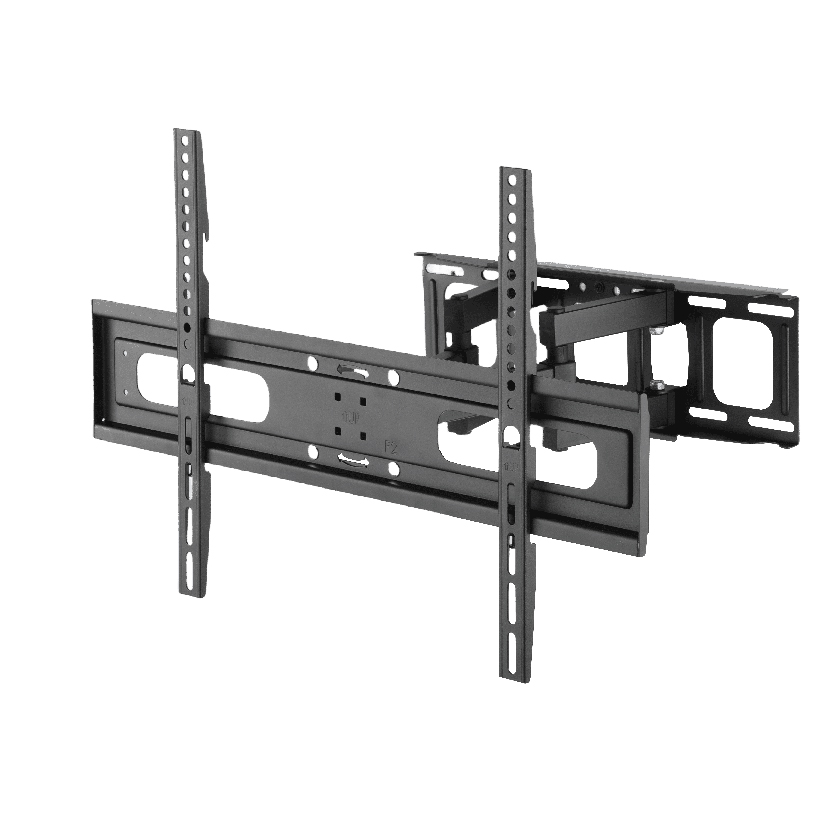
The argument for a full motion TV mount becomes compelling. Its ability to pivot and extend is not a gimmick; it is an essential tool for adapting the screen to the flow of daily life. A versatile mid-range option like the Full Motion TV Wall Mount [506-64] with its 6-arm gas-assisted articulation handles 32–70″ panels up to 110 lbs, covering the bulk of typical living-room demand.
The most common adversary in any living room is glare. Large windows, a gift of natural light, become a source of frustration when they cast bright reflections across your screen. A fixed TV mount offers no recourse.
You are left to draw the curtains, sacrificing daylight for visibility. A full motion mount provides a simple, elegant solution. With a gentle push, you can tilt the screen down or swivel it away from the incoming light, preserving both your view of the screen and the room’s bright atmosphere.
This flexibility is the defining characteristic that separates a full motion mount from its fixed counterpart. It transforms the television from a static object into a responsive element of your home.
A Personal Reflection on Room Dynamics
I once visited a friend who had just moved into a beautiful apartment with a wall of west-facing windows. Proud of his new 75-inch television, he had installed it on a fixed TV mount, aiming for that sleek, gallery-like aesthetic.
The setup looked stunning in the morning. However, as the afternoon sun streamed in, the screen became an almost perfect mirror. What was meant to be the centerpiece of his entertainment became unusable for several hours each day.
He had prioritized form over function and was now paying the price in daily inconvenience. Several months later, after much convincing, we spent a Saturday replacing the fixed mount with a full motion model.
The installation was admittedly more involved, requiring careful measurement and a few more holes in the wall. But the moment the television was back up, the benefit was immediate.
A slight tilt downwards and a small swivel to the left, and the glare vanished completely. He could now enjoy a perfect picture at any time of day, from his sofa, his dining table, or even while standing in the kitchen.
The full motion vs fixed TV mount debate, for him, was settled not by specifications, but by the lived experience of his space.
Step 2: Evaluate Wall Structure and Cable Management
With a clear understanding of your viewing needs, the investigation turns to the physical canvas for your installation: the wall itself. The structural integrity of your wall and your strategy for managing cables are practical considerations that can steer your decision between a fixed or full motion TV mount.
A mount is only as good as its connection to the home, and overlooking these foundational details can lead to disappointment or, in a worst-case scenario, damage. This phase requires a shift from conceptualizing the experience to inspecting the tangible reality of studs, drywall, and the inevitable tangle of wires.
The Anatomy of a Wall Mount: Understanding the Hardware
At their core, all wall mounts serve the same purpose, but their mechanical designs differ profoundly. A fixed TV mount is a model of simplicity. It typically consists of two parts: a wall plate that attaches to the wall and two vertical brackets that attach to the back of the television.
The brackets then simply hook onto the wall plate. There are no moving parts, which contributes to its strength and ease of installation. Streamlined options like the Fixed TV Wall Mount [DF-SL] demonstrate how a minimalist hardware footprint can support large-format displays without visual clutter.
A full motion TV mount is a more complex piece of engineering. It features a wall plate, but connected to it is an articulating arm with multiple pivot points. This arm extends, retracts, swivels, and tilts, providing the mount’s signature flexibility.
This mechanical complexity, however, introduces a critical concept from physics: leverage. When the arm is extended, the television’s weight exerts a much greater pulling force on the wall anchors than it would on a fixed mount.
This amplified stress is a non-negotiable factor in its installation. A 50-pound television extended two feet from the wall can place several hundred pounds of force on the top mounting bolts.
Installation Realities: Simplicity vs. Structural Demands
The installation process for a fixed TV mount is relatively straightforward, making it a popular choice for do-it-yourself enthusiasts. The primary task is to locate two wall studs and securely fasten the wall plate to them.
Because the force is primarily a downward shear force, the installation is quite forgiving as long as it is anchored to the studs. The lack of moving parts means there is little to assemble and fewer points of potential failure.
Installing a full motion TV mount demands a higher level of precision and care. Due to the leverage effect, it is absolutely imperative that the mount is fastened securely into the center of solid wood studs or a concrete wall.
Mounting a heavy, articulating arm on drywall with anchors is a recipe for disaster. Professional installers often use more robust hardware, like lag bolts, and pay meticulous attention to ensuring the wall plate is perfectly level, as any slight tilt will be exaggerated when the arm is extended.
Heavy-duty configurations such as the Full Motion TV Wall Mount [120-84]—engineered to support 84-inch panels at 220 lbs—require especially robust wall preparation, and the choice here involves an honest assessment of your DIY skills and the construction of your walls.
| Aspect | Fixed TV Mount | Full Motion TV Mount |
|---|---|---|
| Required Skill Level | Beginner to Intermediate | Intermediate to Advanced |
| Wall Stress | Low; primarily downward shear force | High; significant outward pulling force when extended |
| Stud Requirement | Must anchor to studs | Absolutely must anchor securely to studs |
| Installation Time | Typically under 1 hour | Typically 1-2 hours |
| Cable Access | Difficult once mounted | Easy; pull TV away from the wall |
| Risk of Error | Low; forgiving | Higher; mistakes can lead to wall damage or TV failure |
The Unseen Challenge: Taming the Cable Octopus
One of the most frequently overlooked aspects of mounting a television is cable management. A beautifully mounted TV can be aesthetically ruined by a visible nest of wires dangling below it.
Here, the two mount types present a classic trade-off between aesthetics and convenience. A fixed TV mount, by holding the television close to the wall, offers the potential for the cleanest look.
With careful planning, you can install an in-wall power and cable kit behind the TV, making all wires completely disappear. The downside is access. Once that television is clicked into place on its mount, the space behind it is incredibly tight.
Plugging in a new gaming console or a soundbar can become a frustrating ordeal of blindly fumbling for ports, sometimes even requiring you to lift the heavy screen off the mount entirely.
A full motion TV mount, conversely, is a champion of convenience. Need to access the back of your TV? Simply pull the screen away from the wall. This makes connecting new devices, troubleshooting issues, or even just dusting a simple and painless process.
The trade-off is that it is more challenging to achieve a perfectly invisible cable setup. While many full motion mounts have built-in cable management channels along the arm, the cables must have enough slack to move as the arm articulates.
The gap between the TV and the wall is also larger, making it slightly harder to completely conceal cable routing solutions. The full motion vs fixed TV mount decision often comes down to whether you prioritize one-time aesthetic perfection or ongoing practical access.
Step 3: Consider Aesthetics and Interior Design Goals
After navigating the practicalities of viewing habits and wall structures, the focus shifts to the more subjective realm of aesthetics. A television is a dominant feature in any room, and how it is mounted has a significant impact on the space’s overall look and feel.
The dialogue between a full motion vs fixed TV mount extends into the language of interior design, where concepts like minimalism, functionality, and spatial harmony come into play. Your choice will either make the television recede into the background or highlight its role as a dynamic, functional object.
The Minimalist Ideal: The “Floating Picture” Effect
For those who subscribe to a minimalist design philosophy, the goal is often to reduce visual clutter and celebrate clean lines. In this context, a television can be seen as a visual interruption, a large black rectangle on an otherwise serene wall.
A fixed TV mount is the minimalist’s best ally in mitigating this effect. By positioning the screen as close to the wall as possible—sometimes less than an inch away—it creates an illusion that the television is a piece of digital art or a “floating picture” rather than a bulky electronic device.
This low-profile appearance integrates seamlessly with modern and contemporary decor. There is no visible hardware, no distracting mechanical arm. The focus remains on the content on the screen or the clean geometry of the room when the TV is off.
For minimalists who still want some movement capability, ultra-slim engineered options like the Ultra Thin Full Motion TV Mount [CB-G] bridge the gap, retracting nearly flush while preserving articulation.
It communicates a sense of permanence and intention, suggesting the television’s placement was a deliberate design choice, not a functional afterthought. For a homeowner who has carefully curated every element of their space, the unobtrusive nature of a fixed TV mount is its most powerful feature.
The Pragmatist’s Choice: Function Over Form
A full motion TV mount, by its very nature, makes a different aesthetic statement. It embraces its mechanical identity. While many models are designed to be as sleek as possible, the articulating arm is an undeniable piece of hardware.
When the television is fully retracted, the mount is less noticeable, but it still creates a larger gap between the screen and the wall compared to a fixed mount. When extended, it is an unapologetically functional apparatus.
This is not necessarily a negative attribute; it is simply a different design choice. The aesthetic of a full motion mount is one of pragmatism and capability. It suggests that the room is a flexible, living space where function is highly valued.
For many, the immense practical benefits of being able to eliminate glare, share the screen with others in the room, or easily access ports far outweigh the slight compromise in minimalist purity.
The design choice here is to prioritize the dynamic experience of using the television over the static appearance of the television when it is off. It is a decision that favors interaction over passive observation.
The Corner Conundrum and Awkward Walls
Interior design is not always about achieving an ideal; often, it is about solving problems. Many rooms, particularly in older homes, present architectural challenges that defy a simple, centered television placement.
You might have a fireplace that dominates the main wall, a window positioned right where the TV should go, or studs that are inexplicably off-center. In these situations, a full motion TV mount transcends being a luxury and becomes a brilliant problem-solver.
Mounting a television in a corner is a classic example. A fixed mount would leave the screen awkwardly angled and visually unbalanced. A full motion mount, however, can be mounted to a stud on one of the corner walls, and its articulating arm can then extend and pivot the television so it floats perfectly across the corner, facing the room’s seating area.
Models like the Full Motion TV Wall Mount [340EX] (23–55″, 77 lbs) and the Full Motion TV Wall Mount [860-64] (154 lbs dual-arm) excel in these challenging architectural scenarios by providing extensive reach and pivot range.
Similarly, if the studs in your wall are not centered where you want the screen to be, you can mount the full motion arm off-center and use its swivel function to perfectly position the television in the desired spot.
It provides a level of architectural forgiveness that a fixed mount simply cannot offer. This ability to correct for a room’s imperfections is one of the most powerful, albeit less-discussed, arguments in the full motion vs fixed TV mount debate.
Step 4: Analyze Long-Term Needs and Future-Proofing
A television mount is not a disposable accessory; it is a semi-permanent piece of infrastructure in your home. A thoughtful decision, therefore, extends beyond your immediate needs and considers the future.
How might your technology change? How might your use of the room evolve? Engaging in this forward-thinking analysis can prevent future frustrations and ensure your investment remains valuable for years to come.
The full motion vs fixed TV mount discussion becomes a question of adaptability versus stability over the long term.
Accessing Ports and Upgrading Devices
The world of consumer electronics moves at a breathtaking pace. The soundbar you buy today might be replaced by a more advanced system in three years. A new generation of gaming consoles with different connection requirements is always on the horizon.
Your need to access the ports on the back of your television is not a one-time event; it is a recurring reality. Here, the practical difference between the mount types becomes starkly apparent.
With a fixed TV mount, each new device can trigger a moment of dread. You face the choice of attempting to blindly plug in cables in a space barely wide enough for your hand, or undertaking the two-person job of lifting the television off the wall.
It is a significant barrier to the simple act of upgrading your setup. A full motion mount eliminates this friction entirely.
The ability to pull the television away from the wall transforms the task from a frustrating chore into a simple, two-minute job. This ease of access is a profound quality-of-life improvement that pays dividends over the entire lifespan of the television.
It encourages you to adopt new technology rather than avoid it due to hassle. In a 2026 world where device ecosystems are constantly evolving, this built-in accessibility is a powerful form of future-proofing.
Room Reconfiguration and Changing Lifestyles
Our lives are not static, and neither are our living spaces. The way you use a room today might not be how you use it in five years. You might decide to rearrange your furniture for a fresh look, or your family might grow, changing how the space is utilized.
A home office corner might appear, or a children’s play area might take over a section of the room. A fixed TV mount anchors your room’s layout.
Because it dictates the single optimal viewing spot, it locks your primary seating arrangement into place. Any significant furniture reconfiguration would either compromise the viewing experience or necessitate the arduous process of demounting, patching holes, and remounting the television elsewhere.
A full motion TV mount offers a liberating degree of freedom. It decouples the television’s position from the furniture arrangement.
If you move your sofa from one wall to another, you can simply swivel the screen to face the new location. If a new armchair is added to the side, the screen can be angled to include that viewer.
This adaptability ensures that your investment in a high-quality television and mounting system continues to serve you well, regardless of how your life and your living space evolve. It is a choice for a dynamic home rather than a static one.
The Cost-Benefit Analysis Over Time
On the surface, the financial calculation seems simple: fixed TV mounts are significantly less expensive than their full motion counterparts. This initial cost difference is a valid and important factor for many people.
However, a more complete analysis considers the long-term value and the hidden “costs” of inconvenience. The upfront savings of a fixed mount might be eroded over time by the cost of frustration.
What is the value of the hour you spend struggling to plug in a new device? What is the cost of the daily annoyance of afternoon glare on your screen? While these costs are not monetary, they impact your enjoyment of your home.
Conversely, the higher initial investment in a full motion TV mount can be seen as purchasing long-term convenience, flexibility, and peace of mind. The cost is front-loaded, but the benefits—easy access, glare control, and adaptability—are delivered daily for the life of the installation.
When viewed through this lens, the price difference often seems less like an expense and more like a worthwhile investment in a better, more functional living experience. The final decision should account not just for the price tag today, but for the value delivered over the next decade.
Step 5: Making the Final Decision: A Synthesis of Factors
Having journeyed through the considerations of environment, structure, aesthetics, and future needs, the time has come to synthesize these insights into a final, confident choice. There is no universally “better” option in the full motion vs fixed TV mount debate; there is only the option that is better for you.
The right decision is found by weighing the competing virtues of minimalist form and dynamic function against the unique backdrop of your home and life.
The Case for the Fixed TV Mount
You should choose a fixed TV mount if your values and environment align with its specific strengths. This is the right choice for the purist, the minimalist, the individual who has a dedicated space for viewing media.
Consider a fixed mount if:
- You have a single, primary seating area positioned directly in front of the television.
- Your room has controlled lighting, or windows do not cause significant glare on the screen.
- You prioritize a clean, ultra-low-profile aesthetic where the television appears to be part of the wall.
- Your technology setup is simple and stable; you do not anticipate frequently adding or changing devices connected to your TV.
- You are looking for the most straightforward installation process and the most budget-friendly option.
For this person, the functional limitations of a fixed mount are not limitations at all, because the need for movement simply does not exist. The choice is an affirmation of simplicity and design purity.
The Case for the Full Motion TV Mount
You should choose a full motion TV mount if your lifestyle and living space demand adaptability. This is the right choice for the pragmatist, the problem-solver, the family living in a dynamic, multi-purpose space.
Consider a full motion mount if:
- Your room has multiple viewing angles—a kitchen island, a dining table, a side chair—from which you want to watch TV.
- Your room suffers from glare from windows or lights, and you need the ability to tilt and swivel the screen to counteract it.
- You frequently connect new devices like gaming consoles, streaming sticks, or sound systems and value easy access to the TV’s ports.
- You need to mount your television in a corner or on a wall with off-center studs.
- You value long-term flexibility and want your setup to adapt to future changes in furniture arrangement or lifestyle.
For this person, the additional cost and more complex installation are a small price to pay for the immense functional freedom a full motion mount provides.
Beyond the Binary: The Tilting Mount Alternative
It is worth remembering that the choice is not strictly binary. A third category, the tilting mount, offers a compelling middle ground.
As the name suggests, a tilting mount is similar to a fixed mount but allows for vertical tilting, typically up to 15 degrees downward. A tilting mount is an excellent solution for specific scenarios.
Its most common application is when the television must be mounted higher than the ideal eye level, such as over a fireplace. Tilting the screen downward corrects the viewing angle, reducing neck strain and improving picture quality.
Slim-profile tilt options like the Tilt TV Wall Mount [CT64]—with a 45mm profile and -10° tilt range—and the lighter-duty Tilt TV Wall Mount [CT44] deliver this corrective capability without sacrificing the low-profile aesthetic.
It is also effective for combating glare from overhead lights or high windows. While it lacks the side-to-side swiveling capability of a full motion mount, it provides a crucial degree of adjustment that a fixed mount lacks, at a price point and installation complexity that is much closer to a fixed mount than a full motion one.
For those whose only problem is vertical angle or glare from above, the tilting mount is often the perfect, targeted solution.
ThunderTech Pros: Engineered Mounting Solutions for Every Need
Choosing the right mount type is only half the equation—the manufacturer behind the bracket determines whether your investment will hold up over the next decade. ThunderTech Pros has spent 16 years building exactly that kind of confidence.
From its 45,000 m² vertically integrated facilities across China and Thailand, ThunderTech Pros runs over 100 stamping machines, automated welding robotics, and two powder coating lines, all governed by ERP-driven traceability. The result is batch-to-batch consistency at scale—tens of millions of units annually—across the full mounting spectrum.
Below are five hero products that anchor the catalog and showcase the engineering depth available to brands, retailers, and end-users alike.
Heavy-Duty Flagship: Full Motion TV Wall Mount [120-84]
For commercial signage, large-format home theaters, and premium installations demanding maximum capacity, the Full Motion TV Wall Mount [120-84] supports panels up to 84 inches at 220 lbs.
This is the workhorse for retailers needing a flagship SKU that handles ultra-large displays without compromise.
Mid-Range Volume Driver: Full Motion TV Wall Mount [506-64]
The Full Motion TV Wall Mount [506-64] covers the bulk of retail and Amazon demand—32 to 70 inches, 110 lbs capacity, 6-arm gas-assisted articulation.
Its sweet-spot specs make it a top choice for private-label programs targeting mainstream living-room buyers.
Slim-Profile Tilt: Tilt TV Wall Mount [CT64]
For installations above fireplaces or in rooms with overhead glare, the Tilt TV Wall Mount [CT64] delivers a 45mm profile with a -10° downward tilt.
It hits the cost-to-function balance that DTC brands need for their tilt mount listings.
Minimalist Fixed Option: Fixed TV Wall Mount [CF44]
The Fixed TV Wall Mount [CF44] serves the entry-level fixed mount segment, holding the TV nearly flush against the wall for that picture-frame aesthetic.
Streamlined hardware and straightforward installation make it a strong everyday SKU.
Hybrid Use Case: Gas Spring Monitor TV Mount [QTH-2E]
Bridging desk-mount monitors and large-format displays, the Gas Spring Monitor TV Mount [QTH-2E] handles displays up to 60 inches and 40 kg with VESA patterns up to 400×400mm.
Ideal for ultrawide monitors, digital signage, and prosumer command-center setups.
Whether you are a brand sourcing for Amazon and Walmart, a retailer building a private-label program, or a distributor stocking AV channels, ThunderTech Pros provides end-to-end ODM/OEM support—from custom engineering and tooling through compliant, certification-ready mass production.
Frequently Asked Questions (FAQ)
Can a full motion mount securely hold a large, heavy television?
Yes, absolutely. Reputable full motion mounts are engineered and tested to safely support the weight and size specifications listed by the manufacturer. The key to security is not the mount itself, but proper installation.
The mount must be anchored with appropriate hardware (like lag bolts) into solid wood studs or a concrete wall to handle the leverage forces when the arm is extended.
How close to the wall can a full motion TV mount get when retracted?
This varies by model, but modern, high-quality full motion mounts are designed to have a surprisingly low profile. When fully retracted, many models can sit just two to three inches from the wall.
While this is not as flush as a fixed mount (which can be under an inch), it is often sleek enough for most aesthetic tastes.
Is it difficult to install a TV mount by myself?
A fixed or tilting mount is a manageable DIY project for someone with basic tools and comfort in locating studs and using a level. A full motion mount, especially for a large TV, is more challenging due to the weight of the mount and the critical importance of secure anchoring.
For larger screens or if you have any doubt about your wall structure, hiring a professional installer is a wise investment for safety and peace of mind.
Do full motion mounts sag or become loose over time?
High-quality full motion mounts from reputable brands are designed with durable materials and tight tolerances to prevent sagging. Cheaper, poorly made mounts can develop “droop” at the joints over time.
The best way to avoid this is to invest in a well-reviewed product from an established manufacturer and ensure you do not exceed the mount’s specified weight capacity.
How do I find the studs in my wall for installation?
The most reliable method is to use a quality electronic stud finder. These devices detect changes in density behind the drywall to locate the edges and center of the wood studs.
For confirmation, after marking the stud’s location, you can use a small nail to gently tap through the drywall in the area that will be covered by the mount to ensure you have hit solid wood.
What is the best way to hide cables with a full motion mount?
There are two main strategies. First, many full motion mounts come with plastic covers that clip onto the articulating arm, allowing you to route the cables along the arm itself for a tidy look.
Second, for a cleaner connection from the wall to the mount, you can use a paintable cord cover that runs down the wall or, for the most seamless look, install an in-wall power and cable management kit near the base of the mount.
Conclusion
The decision between a full motion and a fixed TV mount is ultimately a personal reflection of how you live. It is an inquiry into the balance you seek between form and function, between aesthetic stillness and practical dynamism.
There is no single correct answer, only an informed choice that aligns with the realities of your space and the rhythm of your life. By carefully considering your viewing habits, the architecture of your room, your design aspirations, and your future needs, you can move beyond the product specifications and select a mount that will not just hold your television, but enhance your experience of it for many years.
The perfect mount is the one that disappears, either visually into the wall or functionally into the effortless flow of your daily routine.