
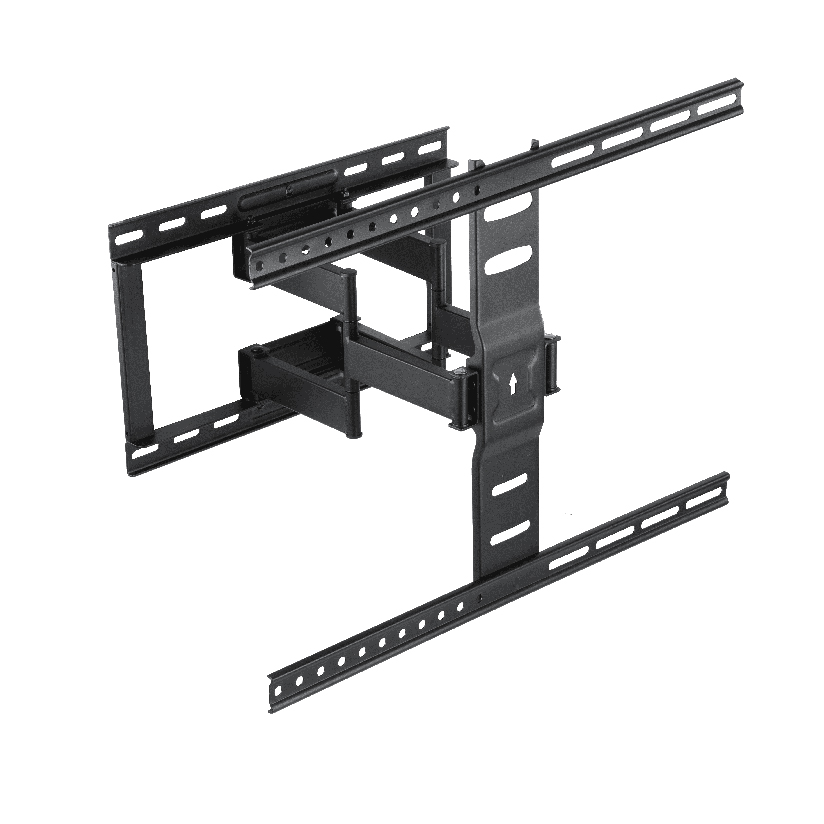
You have a screen to hang, a corner you want it to swing toward, and a shopping cart that already has a mounting dream full motion tv wall mount sitting in it. Mounting Dream is one of the most searched names on Amazon for a reason: the price is friendly, the listings are clear, and the box shows up in two days. Before you check out, it helps to know what those arms actually do, where this kind of mount is the right call, and where a homeowner with a heavy screen or a long-term install might want to look at a vertically integrated brand instead. This is a fit question, not a ranking.
What you are really buying with a full-motion arm
A full-motion mount lives or dies on three numbers and one quality you cannot see in a photo. The numbers are weight rating, VESA pattern, and arm extension. The hidden quality is how consistent the steel and the joints are from one unit to the next, because that is what decides whether the arm still holds its angle two years after you bolt it up.
Mounting Dream covers the popular middle of this market well. Its full-motion arms typically support common sizes in the 32 to 65 inch range, hit VESA patterns up to 600x400mm on the larger models, and extend far enough to pull a TV out of a corner. For a single mid-weight screen on a stud wall, that is usually all a room needs. The trade-off shows up at the heavy end and over time, which is where build consistency starts to matter more than the spec on the box.
It helps to separate the two things people lump together. Arm reach is how far the screen pulls off the wall, and it solves viewing-angle problems in a long room or an open-plan space. Tilt and swivel are how the screen aims once it is out there, and they solve glare and seating-height problems. A long arm with stiff swivel can still feel awkward, and a short arm with smooth motion can feel great in a small room. Reading both numbers, not just the headline reach, is how you avoid buying more arm than your wall or your viewing distance actually wants.
The numbers that separate one arm from another
When people write a mounting dream tv mount review, they tend to focus on price and ease of install, and those are fair points. But the spec that quietly drives long-term satisfaction is the ratio of your TV’s weight to the mount’s rating. A mount loaded near its maximum sags sooner than the same screen on a mount with headroom to spare.
Here is the order a homeowner should check before buying any articulating mount:
- Confirm your screen weight against the rating. Find your TV’s weight in its manual, then pick a mount rated well above it. If you want a heavy duty full motion tv mount, look for a rating with a clear margin over your screen, not one that just barely clears it.
- Match the VESA pattern. Measure the hole spacing on the back of your TV (horizontal by vertical, in mm) and confirm the mount lists that exact pattern. A full motion tv wall mount for 65 inch screens usually needs 400x400mm or 600x400mm.
- Check arm extension and fold-flat depth. Longer reach is better for corners, but it also puts more pull on the studs, so confirm your wall can take it.
- Plan the wall anchors. Drywall with studs, concrete, and brick each need different hardware. Confirm what ships in the box.
- Verify the safety paperwork. Certifications such as UL or TÜV tell you the design passed an independent load review, not just an internal one.
Run those five and most fit problems disappear before you ever pick up a drill.
Mounting Dream and ThunderTech Pros, side by side
A clean way to think about the choice is to compare the two on the factors that actually drive the decision, rather than on overall reputation. The table below lines them up on measurable points. Prices are rough US street ranges and vary by model and screen size.
| Factor | Mounting Dream (Amazon value line) | ThunderTech Pros (vertically integrated) |
|---|---|---|
| Typical load rating | 66 to 99 lbs | Up to 77 lbs on the 340EX, higher on larger models |
| VESA support | Up to 600x400mm | Up to 600x400mm |
| Arm extension | Long reach on bigger models | Long reach with consistent joint tolerance |
| Certifications | Varies by model | ISO 9001:2015, TÜV, BSCI, UL |
| Where to buy | Mainly Amazon | Walmart, Costco, Amazon, Lowe’s |
| Typical price | $30 to $80 | $40 to $120 |
Both land in similar territory on the headline specs, which is the honest takeaway. The difference is less about a single number and more about how the hardware is made and where you can get it. That brings the comparison to production.
One detail worth pulling out of the table is the certification line. A model that lists UL or TÜV testing has had its load claims checked by an outside lab, which is reassurance you cannot get from a photo or a star rating. Mounting Dream lists certification on some models and not others, so it pays to read the specific listing rather than assume the brand-wide answer. If the screen is going over a couch where people sit, or in a rental where you want documentation, that line moves from nice-to-have to something worth confirming before you buy.
Where each one is the better fit
This is the part that matters more than any score. When Mounting Dream fits, it really fits, and there is no reason to overspend.
- When Mounting Dream fits. You have a standard-size screen in the 32 to 65 inch range, a budget you want to keep tight, and you value getting the box in two days from Amazon. For a guest room, a bedroom, or a first apartment, the value here is hard to beat and the install is straightforward.
- When ThunderTech Pros fits. You have a large or heavy screen near the top of a rating, you want the arm to hold its angle for years without creep, you care about certification paperwork for a rental or a wall you cannot easily redo, or you would rather buy in store at Walmart, Costco, or Lowe’s and handle returns locally.
Neither answer is automatic. A 50 inch TV in a bedroom does not need factory-grade tolerances, and a 75 inch screen over a fireplace benefits from every bit of margin and consistency you can get.
How ThunderTech Pros approaches the same problem
ThunderTech Pros manufactures its mounting hardware in its own ISO 9001:2015 certified factories, with 17 years of production experience across TV mounts, monitor arms, and AV mounting solutions. The practical effect of owning the factory rather than ordering assembled units is tighter control over steel grade and joint tolerance, so the arm that ships to you behaves like the one the engineers tested.
For a heavy or long-term install, that consistency is the point. The ThunderTech Pros 340EX full-motion mount is rated to 77 lbs and supports VESA up to 400x400mm, and the larger models carry the load and reach that big screens need. Because the brand supplies Walmart, Costco, Amazon, and Lowe’s, you can buy it the same fast way you would order a mounting dream full motion tv wall mount, or you can pick it up in store and return it locally if the fit is wrong. You can browse the current full-motion and AV lineup on the ThunderTech Pros product range and check ratings against your screen before you commit.
To be clear, this is not a knock on the Amazon value line. Mounting Dream earns its place for the buyer who wants a proven, affordable arm for a common screen size. ThunderTech Pros earns a look from the buyer who is loading the rating hard, wants certification on file, or prefers multiple retail channels.
Picking by your own situation
If you are still running the mounting dream vs thundertech pros question in your head, sort it by your screen and your wall rather than by brand loyalty.
- Mid-size screen, tight budget, Amazon shopper: the value line is the sensible pick, and you will not feel the difference day to day.
- Large or heavy screen, long-term install: prioritize load margin and joint consistency, which favors a vertically integrated maker.
- Rental or shared space needing paperwork: choose the option with clear UL or TÜV certification on the listing.
- You prefer in-store buying and returns: lean toward a brand stocked across Walmart, Costco, and Lowe’s, not Amazon alone.
Anyone shopping for the best full motion tv mount for their room is really shopping for the right match between screen weight, arm reach, and where they want to buy, not a single winner.
Match the mount to the screen, then buy
Start with your TV’s weight and VESA pattern, because those two numbers rule out half the catalog before brand ever enters the conversation. If your screen is mid-size and your budget is the priority, a mounting dream full motion tv wall mount is a sound, fast choice. If your screen is heavy, your install is permanent, or you want certification and in-store support behind the hardware, compare it against a vertically integrated maker like ThunderTech Pros on load margin and tolerance. Confirm the rating, confirm the VESA holes, confirm your wall, and the arm you pick will swing clean for years.