
A buyer sends out an RFQ for a TV mount, gets several quotes back, and finds that none of them describe quite the same product. One supplier priced a fixed plate, another priced a tilting version, and a third assumed a different arm length because the request never fixed one. Nobody is being dishonest; the request simply left room for interpretation, and each factory filled that room with its own default. The gap shows up later, when a sample arrives with the wrong finish or a carton reaches a customer without the wall hardware the listing promised. An RFQ is not a price request, it is the first written description of the product you intend to sell. This article walks through the definitions a TV-mount RFQ should carry before anyone cuts steel: product form and model, drawing revision and functional requirements, material and finish and hardware pack, inspection and sample and document records, and the pack and marking handoff that closes the loop.
Start with the product form, not the product category
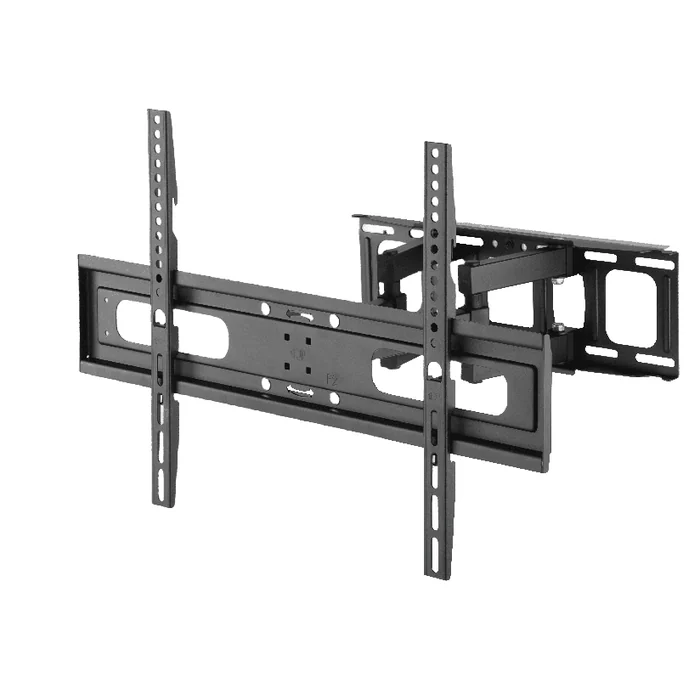
“TV mount” is a category, not a specification. Within it sit fixed low-profile plates, tilting mounts, full-motion articulating arms, ceiling mounts, floor and rolling stands, and desk-clamped monitor arms. Each of these is a different mechanical design with a different bill of materials, so an RFQ that names only the category invites suppliers to quote whichever form is cheapest for them to make. The quotes then look wildly different in price, and the difference tells you nothing useful about the suppliers.
Name the form first, then the variant depth you actually need.
- Motion type. Fixed, tilt, swivel, or full motion with extension and retraction.
- Mounting interface. Wall, ceiling, stand, cart, or desk clamp and grommet.
- Variant family. Whether one RFQ covers a single size or a size ladder that shares tooling and hardware.
Decide whether you are buying one SKU or a family
This is a quiet cost decision. A single SKU is simple to quote and simple to inspect. A multi-size family built on shared brackets and a shared hardware pack costs more to define up front, because each size needs its own drawing and its own carton, but it lets you present one product line to your channel instead of three unrelated items. If you intend to grow into a family later, say so in the RFQ even when you are only ordering one size now. Suppliers plan the arm, plate, and packaging differently when they know a second size is coming, and the parts are much harder to align retroactively.
Fix the display range the mount is sold against
Every mount you sell will be described to an end user by screen size range and weight capacity, so those two numbers belong in the RFQ rather than in the marketing copy written afterwards. State the screen diagonal range and the maximum display weight the product must be rated for, and state the display mounting hole patterns it must accept. The RFQ has to give the display mounting-hole pattern the product is required to accept, and the pattern range you name drives the size of the display brackets and the length of their slots. If you leave this open, you have not really specified a product; you have specified an appearance.
Turn the requirement into a drawing revision
Words describe intent, drawings describe parts. The point in an RFQ where most later disputes are settled or created is the moment the requirement becomes a controlled drawing with a revision number on it. Until that exists, “the mount we agreed on” means whatever each side remembers.
Name the revision that governs the quote
Ask that every quote reference a specific drawing revision, and that any change to that drawing produce a new revision rather than a quiet edit. This matters because quotes, samples, and inspections all have to point at the same document. When a supplier proposes a design change to improve manufacturability, that proposal is useful, but it should arrive as a marked revision you approve, not as a difference you discover in the sample. Keep the revision history somewhere both sides can cite.
Separate cosmetic requirements from functional ones
Not every dimension deserves a tight tolerance, and treating them all as critical raises cost without raising quality. Sort your requirements into two groups. Functional requirements govern whether the product works and holds: plate thickness, weld locations, pivot fit, fastener grades, slot dimensions, and the range of motion at each joint. Cosmetic requirements govern how the product looks on a shelf or a wall: finish uniformity, edge appearance, logo placement, and visible tool marks. Both belong in the RFQ, but they should be labelled, because a supplier who knows which dimensions are critical can hold them properly instead of averaging its attention across the whole part.
Describe the motion, not just the geometry
For tilting and full-motion products, the behaviour of the mechanism is part of the product. Define the tilt and swivel ranges you need, whether extension should hold position without drifting, whether tension is user-adjustable, and how the mount is expected to behave when a display is attached at the low and high ends of the weight range. These are the characteristics a reviewer will describe as feeling cheap or solid, and they are almost never captured by a dimensioned drawing alone. Write them as requirements the sample will be judged against.
Specify material, finish, and the hardware pack
A TV mount is a steel assembly plus a bag of fasteners, and buyers routinely specify the steel carefully and the bag not at all. Both halves reach the end user, and the bag is what they open first.
Material and thickness belong in the RFQ, not in the reply
State the material and gauge for load-bearing parts rather than asking suppliers to propose them. If you invite proposals, you will receive several different constructions at several different prices, and comparing them becomes a design review rather than a sourcing exercise. Where you genuinely want supplier input, say so explicitly for that part and hold the rest fixed. Also state whether any part may be substituted, because unstated substitution freedom is usually exercised.
Finish is a durability requirement as much as an appearance one
Name the finish system and the colour reference, not just the colour word. State the finish type, the colour and gloss reference, and the appearance acceptance requirements that apply to edges and welds. If the product will be sold into environments with moisture or handled frequently in retail display, say that in the RFQ so the finish requirement has a reason attached to it. Where you want a specific surface test applied, name the test and the acceptance criterion in writing and confirm with the supplier that the requirement is accepted before production, rather than assuming it is standard practice.
Define the hardware pack item by item
If the hardware pack is incomplete or does not match the instructions, it can become a source of returns. Specify the wall fasteners, the display screws and their thread sizes and lengths, the washers and spacers, any wrench or bit included, and the drill template or spacer card if the design uses one. State which wall constructions the supplied wall hardware is intended for and which are explicitly out of scope for the included kit, so your instructions and your carton contents agree. Then state how the pack is organised: one bag, labelled sub-bags by step, or a blister tray. That organisation decision affects assembly time at the factory and frustration at the customer, and it costs nothing to decide early.
Say which records prove the product before you accept it
An RFQ that defines the product but not the evidence leaves the acceptance conversation for later, when a container is already packed. Define the records at the same time as the requirements.
Sample stages, and what each stage is for
Distinguish the sample types instead of asking generically for “a sample”. Stages you may agree with a supplier include a first-off or engineering sample intended to confirm geometry and fit against the drawing, a pre-production sample intended to confirm finish, hardware pack, printed materials, and packaging together, and an approved reference sample held as the physical reference for later inspections. State which stages your project requires, what each one must demonstrate, and that approval will be given in writing against the named drawing revision. Ask the supplier to confirm which stages and lead-in steps it can commit to for your project rather than assuming any stage is included.
Inspection points and acceptance criteria
Say where inspection happens and against what. Points you may choose to specify include incoming material verification, in-process checks on welds and critical dimensions, and a final random inspection covering function, finish, pack contents, and carton condition. For each, name the criterion that decides pass or fail. “Good quality” is not a criterion; a dimension with a tolerance, a defined range of motion, and a checklist of pack contents are. If you intend to use a third-party inspection body, say so in the RFQ so the supplier can plan access rather than negotiate it.
The document set that travels with the product
List the documents you expect to receive and when. Typical items are the approved drawing set, a bill of materials at the level of detail you require, inspection reports for the run, any test or material documentation you have agreed in writing, the artwork proofs for printed material, and the packing list. If a specific listing, standard, or test report is required for the market you sell into, name it explicitly in the RFQ and get written confirmation of scope and status from the supplier rather than inferring it from a catalogue.
Close the loop on product, pack, and marking

The last section of an RFQ is the one most often left to the factory, and it is the part your customer actually sees.
Branding and marking on the product
Decide whether the product carries your brand, the manufacturer’s, or nothing. Then specify how: printed, etched, embossed, a label, or a moulded feature, and where on the part. Specify the model marking and any identifier you need for warranty or service lookups, along with the label material and whether it must survive the finish process or be applied after it. If a serial or batch identifier is needed for traceability, state the format and where it appears, on the product and on the carton.
Packaging as a specified deliverable
Treat the carton the way you treat the mount. Define the inner protection, the carton construction, the graphics or plain-brown requirement, the barcode symbology and where it prints, and the artwork approval step. Say what goes inside besides the product and hardware: the instruction sheet, the language versions required, the warranty or registration card, and anything the channel demands. Where a retail channel imposes packaging or labelling rules, attach those rules to the RFQ rather than describing them from memory.
Write the change process into the RFQ
Products change after the first run, so define now how a change gets made. A workable rule is simple: any change to the drawing, material, finish, hardware pack, or packaging requires a new revision, written approval, and a statement of whether a new sample is needed. Stating the rule in the RFQ also protects the supplier from being held responsible for a change you approved. Without a written change process, a revision difference can go unnoticed when a repeat order is placed.
Bringing a complete RFQ to a mounting-product manufacturer
Once the definitions above are written down, the supplier conversation gets much shorter, because you are asking for a price on a described product rather than an opinion on an idea. Ask a mounting-product manufacturer to respond to the RFQ point by point, including the drawing revision, the hardware pack, and the marking plan.
ThunderTech Pros manufactures display-mounting hardware as its product line rather than as an occasional job, including fixed and full-motion TV wall mounts, monitor arms, and stands. Its published product range is a useful reference for how a mount family is actually described, and an individual record such as the full-motion TV wall mount 340EX shows the level of product detail an OEM programme works from. Reviewing an existing product record alongside your own draft RFQ is a quick way to find the definitions you have left implicit.
When you approach any mounting-product manufacturer, including ThunderTech, treat the following as questions to be answered in writing for your specific project rather than as assumptions: which of your requirements the supplier accepts as stated, which it proposes to change and why, which sample and inspection stages it will commit to, what document set it will provide, and how changes will be handled after the first approval. Nothing in this article establishes what any supplier can commit to for your order; the value of a well-defined RFQ is that it makes those commitments specific enough to confirm.
Common questions about defining an OEM TV mount RFQ
How detailed should an RFQ be if the design is not finished yet?
Send what is fixed and label what is open, instead of waiting for a complete design. State the product form, the display size and weight range, the mounting interface, and the motion behaviour you require, then mark material, finish, or hardware choices as items you want the supplier to comment on. Ask that any supplier suggestion come back as a marked drawing revision you approve rather than as an assumption built into the quote. An RFQ with clearly labelled open items is easier to compare than one that hides the gaps.
Can a supplier’s drawing replace our own drawing set?
It can serve as the controlled document, but only if you review it and approve a specific revision in writing. The risk is not whose CAD file it is; the risk is having no single revision that the quote, the sample, and the inspection all point at. If you work from the supplier’s drawing, make sure it captures your functional dimensions, your motion requirements, your marking, and your hardware pack, not only the parts the factory cares about. Then treat later edits as new revisions that need approval.
What belongs in the RFQ about the hardware pack and packaging?
Everything the end user opens. List the wall fasteners, display screws with thread size and length, washers and spacers, any tool or template included, and how the pack is organised in the carton. For packaging, define the inner protection, the carton construction, the printed material and language versions, the barcode symbology and its placement, and the artwork approval step. These items are easy to leave to the factory by default, so name them in the RFQ instead.