
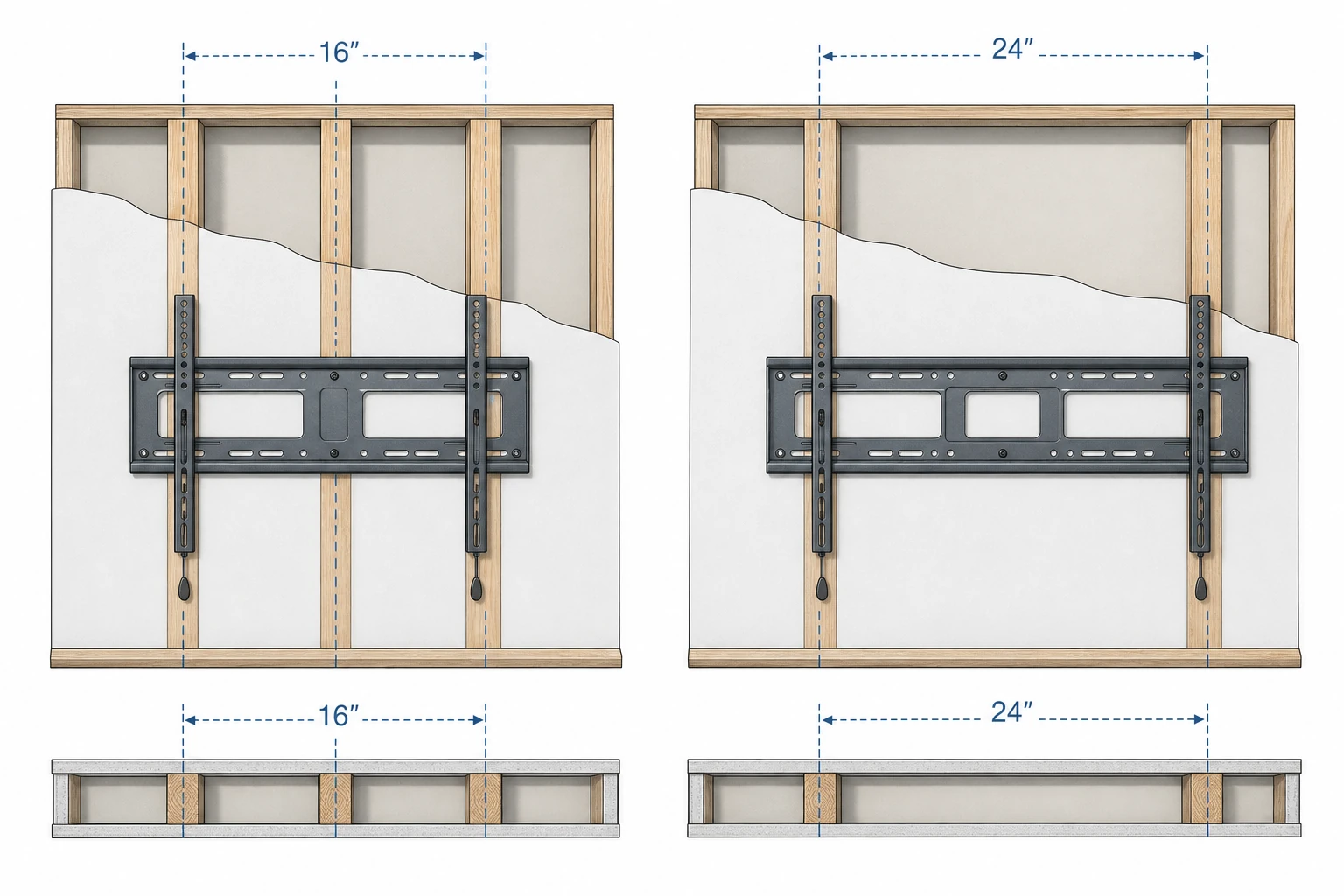
Stud spacing decides which TV mount will actually fit your wall. Most mounts assume 16-inch centers; 24-inch walls need a different approach. Here’s how the two compare, why it matters for load, and the field-proven ways to mount safely on each.
The Quick Answer
16-inch spacing is more common and works with over 90% of standard mounts. 24-inch spacing is structurally sound but needs a wide-plate mount, a plywood bridge, or professional methods — never a standard plate with one side in drywall.
For 24-inch walls, ThunderTech Pros’ 120-84 ships with an expansive slotted plate that spans wide spacing, so you keep a true two-stud anchor.
Key Takeaways
- Studs are typically 16 or 24 inches apart on center — confirm yours first.
- Most mounts fit 16″; 24″ walls need a special solution.
- The 16-vs-24 question is really about load and mount compatibility.
- A wide-plate mount spans 24″ studs directly.
- A plywood panel bridges 24″ studs for any standard mount.
- Improper wide-stud mounting risks failure and TV damage.
Table of Contents
- Understanding Wall Studs
- The Core Dilemma: 16 vs 24
- Solution 1: A Wide-Plate Mount
- Solution 2: A Plywood or Strut Bridge
- Solution 3: Advanced Hardware & Pros
- ThunderTech Pros for Both Spacings
- Frequently Asked Questions
The Unseen Architecture — Understanding Wall Studs
Studs are the vertical framing members that form your wall’s skeleton. Drywall fastens to them but carries almost no load itself — the studs are the anchor points.
In North America the two standards are 16 and 24 inches on center. 16″ became dominant because it divides neatly into 4×8 sheet goods and creates a stiffer wall.
24″ spacing is also code-compliant and saves lumber, common in single-story homes and advanced framing. It’s structurally fine for the house — but trickier for hanging a TV.
Locating Studs Reliably
An electronic stud finder is best — slide it across, mark both edges, find the center. A magnet that catches drywall screws works too.
The “knock test” (hollow vs. solid sound) and outlet locations give clues, but confirm with a small test hole before drilling.
The Core Dilemma — 16 vs 24 Inches
Picture a bridge: piers every 16 feet make a stiffer span than piers every 24 feet. Walls behave the same way.
On a 16″ wall, a TV’s load is shared between two close, well-supported studs. On a 24″ wall, two farther-apart studs each carry more, raising shear and compressive stress.
Full-motion mounts amplify this. An extended arm multiplies force on the bolts, and a 24″ span resists those amplified loads less than a 16″ span.
| Feature | 16-Inch Spacing | 24-Inch Spacing |
|---|---|---|
| Typical use | Most residential, load-bearing walls | Single-story, garages, modern framing |
| Rigidity | Higher; smaller spans per stud | Lower but code-compliant |
| Mount compatibility | 90%+ of standard mounts | Needs a specialized solution |
| Install complexity | Straightforward | Wide plate, plywood, or pro |
Why Most Mounts Are Built for 16″
Manufacturers optimize for the most common spacing, so an 18–20″ plate covers the majority cheaply. Wide-plate mounts cost more in steel and shipping and are typically part of heavy-duty lines.
Risks of Improper 24″ Mounting
One side in a stud and the other in drywall creates an unbalanced load that fatigues and tears out. A wide plate on a single stud can pivot and rip free. The worst case is a fallen TV and a holed wall.
Solution 1: A Specialized Wide-Plate Mount
The cleanest fix is a plate engineered to span 24 inches — 25″ or wider, with continuous slots so the lag bolts align to each stud center.
These plates use thicker steel to stay rigid across the wider span. Confirm VESA support, weight margin, and the right articulation for your room.
Solution 2: A Plywood or Strut Bridge
Already own a 16″ mount? Cut 3/4″ cabinet-grade plywood ~30″ wide, lag-bolt it across both 24″ studs, then attach your mount to the plywood face.
For extreme loads, slotted metal strut across the studs is an even stronger, adjustable alternative. Paint or trim the panel so it reads as an intentional accent.
Solution 3: Advanced Hardware and Professional Help
Heavy-duty drywall toggles can supplement a stud install but should never carry the primary load — drywall has poor tensile strength against pull-out.
Single-stud mounts suit only small, light TVs (roughly under 55″ / 60–70 lb) where one stud lands where you want the screen.
For large or expensive TVs, complex walls, or any uncertainty, a professional brings the right wide-plate hardware, tools, and insurance.
ThunderTech Pros for Both Spacings
ThunderTech Pros builds plates around one idea: spread the load over the widest secure foundation. That serves 16″ walls and solves 24″ walls in a single product.
Wide-span flagship: 120-84
The 120-84 has an expansive slotted wall plate that accommodates various stud spacings, including 24 inches, with thick-gauge steel that won’t flex across the wider span. At 220 lb / 84″ it manages the extended-arm leverage that 24″ walls make more demanding.
Versatile dual-arm: 860-64
The 860-64 (154 lb) offers a wide, rigid plate that anchors cleanly to two studs at either spacing.
Because both plates are designed for genuine two-stud anchoring, you skip the unsafe drywall-anchor workaround whether your wall is 16″ or 24″.
Frequently Asked Questions
Why are my studs 24 inches apart?
For lumber economy and insulation — a code-compliant choice common in single-story and modern construction.
Can I mount a TV on only one stud?
Only with a specialized single-stud mount for small, light TVs. A standard dual-stud mount on one stud is unsafe.
What if I miss the stud?
The bolt holds only soft drywall and will pull out under load. Always confirm solid wood first.
Are stud finders always accurate?
Mostly, but verify with a small probe hole hidden behind the plate.
Can drywall anchors hold a heavy TV?
No. They’re rated for shear, not the pull-out force a TV mount creates. Anchor into studs.