
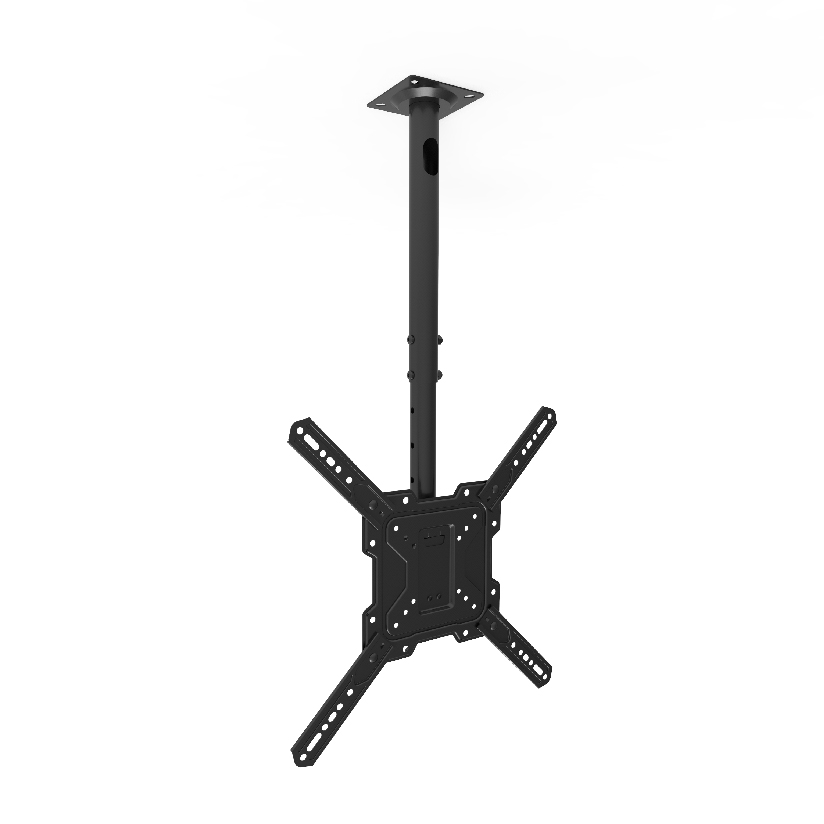
Sometimes there is simply no wall where you want the screen. The kitchen has an island but no flat surface facing it, the bedroom ceiling slopes down toward the bed, or an open-plan loft has nothing but windows. That is where a full motion ceiling tv mount comes in, hanging the TV from a drop pole and letting it swivel, tilt, and rotate from overhead. The hardware looks similar to a wall arm, but the way it carries load and the way you anchor it are different enough that copying a wall install can put a heavy screen over someone’s head. This guide covers when ceiling hanging makes sense, how joist anchoring differs from studs, and how to size the drop and the safety margin.
When hanging the TV from the ceiling actually makes sense
A wall mount is the default for most rooms, so ceiling hanging is worth the extra effort only when the space gives you no good wall. A few situations point clearly toward overhead:
- Open-plan rooms where the viewing spot floats in the middle and no wall faces the couch.
- Kitchen islands and breakfast bars, where you want a screen visible while cooking but the only real estate is overhead.
- Bedrooms with the bed against the long wall, so the natural sightline is up and across rather than straight ahead. People shopping for the best ceiling tv mount for bedroom usually fall in this group.
- Commercial and retail floors, gyms, bars, and waiting areas, where a screen has to be seen from many angles at once.
- Sloped or vaulted ceilings, where a wall mount would aim the picture at the floor. A ceiling tv mount for sloped ceiling uses an adjustable pole and a tilting head to bring the screen back to level.
If a flat wall with studs is available at the right height, use it. Ceiling mounting earns its place when geometry, not preference, rules the wall out.
Why a ceiling mount carries load differently than a wall mount
On a wall, the bracket pulls down and slightly out, and the studs resist that pull in shear. Hang the same TV overhead and the load hangs straight down in tension from the ceiling structure, then swings as a pendulum when you rotate the screen. That changes three things.
First, the anchor point is a ceiling joist, not a wall stud, and joists run in one direction only, so you have less freedom to slide left or right to find solid wood. Second, a full motion arm at the bottom of a drop pole acts like a lever: every inch the screen extends or swivels multiplies the force trying to twist the pole. Third, anything that comes loose overhead falls on whoever is below, so the safety margin has to be larger than a wall job, not equal to it. A drop down ceiling tv mount that is rated right at your TV weight leaves no headroom for that pendulum effect, so size up.
The drop pole length is the other variable wall mounts do not have. The pole sets how far the screen hangs below the ceiling, which controls viewing height. Too short and the TV floats near the ceiling and tilts down at a sharp, neck-craning angle. Too long and it intrudes into the room or blocks a doorway.
Sizing the drop, the load margin, and the swing
The numbers that decide a ceiling install are different from the wall checklist. Work through them before buying any ceiling mount for tv full motion use.
- Measure ceiling height and seated eye level. The center of the screen should land near eye level from where you sit, usually 42 to 48 inches off the floor for a couch, higher for a kitchen island or a bar.
- Calculate the drop pole length. Subtract your target screen-center height from the ceiling height, then account for the mount head and the top of the panel. Many poles are adjustable or sold in fixed lengths from about 12 to 36 inches.
- Weigh the TV and add margin. Take the panel weight and pick a mount rated well above it. Overhead, aim for the mount’s rating to be at least 1.5 times the screen weight, not just over it.
- Confirm the VESA pattern. The bracket on the screen has to match your TV’s hole spacing, commonly 200x200mm up to 600x400mm on larger panels.
- Check the swing and tilt range. A full motion head should swivel side to side and tilt down to correct for the high mounting position, since the screen sits above eye level more often than a wall TV does.
The table below compares the common ceiling configurations on the measures that drive the choice. Prices are rough US street ranges, and the safety margin column shows how far above TV weight to rate the hardware.
| Ceiling setup | Typical price | Max TV weight | Suggested load margin | Tilt to fix angle |
|---|---|---|---|---|
| Fixed ceiling pole | $30 to $60 | 80 to 110 lbs | 1.3x weight | No |
| Tilt-only ceiling mount | $45 to $90 | 70 to 100 lbs | 1.4x weight | Yes |
| Full motion ceiling arm | $90 to $180 | 70 to 110 lbs | 1.5x weight | Yes |
| Sloped-ceiling adjustable | $80 to $160 | 60 to 100 lbs | 1.5x weight | Yes |
The pattern is clear once the screen has to move. A fixed pole is cheapest but locks the viewing angle, which rarely works overhead. A full motion ceiling tv mount costs more because the arm, the pivot, and the pole all have to hold a swinging load, and that is exactly what makes it usable from a couch, an island, and a bed at the same time.
How to anchor into joists, concrete, and sloped ceilings
The anchor is where ceiling installs go wrong, so handle it carefully. Anyone asking how to install a ceiling tv mount should start with what is above the drywall, not with the bracket.
- Wood joists. Find the joist with a stud finder, then confirm by drilling a small test hole. Bolt the ceiling plate through the drywall into solid joist wood with lag screws, never into drywall alone. If the joist does not line up with where you want the screen, add a wood blocking board across two joists and mount to that.
- Concrete ceilings. Common in condos and commercial buildings. Use sleeve or wedge concrete anchors rated for overhead pull-out, and a hammer drill with the correct masonry bit. Concrete holds well, but the anchor rating is everything here.
- Sloped or vaulted ceilings. The plate has to sit flush on the angle while the pole hangs plumb. A ceiling tv mount for sloped ceiling uses a canopy or adapter that pivots to take up the slope, so the TV ends up level even though the ceiling is not.
Whatever the surface, treat the load as live and overhead. Tighten to spec, check that nothing flexes when you pull down with your weight, and never reuse a single drywall anchor for a screen.
Where ThunderTech Pros fits for overhead mounting
ThunderTech Pros manufactures its mounting hardware in its own ISO 9001:2015 certified factories, with 17 years of production experience across TV mounts, monitor arms, and AV mounting solutions. For a ceiling job that consistency matters more than on a wall, because the pole, the pivot, and the joist plate all carry a hanging load that swings, and a weak weld or a loose tolerance shows up faster overhead.
The brand builds a full motion ceiling tv mount with wide tilt and swivel ranges, the kind of movement an overhead screen needs to drop the picture back down to a seated viewer. ThunderTech Pros also carries TÜV and UL certification and supplies through Walmart, Costco, Amazon, and Lowe’s, so the load ratings come from retail safety review rather than a number printed on a box. You can compare the current full-motion and ceiling-capable hardware on the ThunderTech Pros product range before you commit to a drop length.
To keep it honest, ThunderTech Pros is one option among several. Sanus has broad retail reach and a deep catalog, Mounting Dream is a solid value pick on Amazon, and VideoSecu covers the budget end. The right call depends on your ceiling type, your TV weight, and how far the screen needs to swing.
Match the mount to your room before you drill
Start from the room, not the hardware. Open floor plan or kitchen island, pick a full motion ceiling tv mount with full swivel so the picture turns toward whoever is watching. Sloped bedroom ceiling, choose an adjustable canopy and a tilt head so a flat panel reads level over the bed. Concrete commercial ceiling, prioritize the anchor rating over the price tag. Measure the ceiling height, set the drop pole so the screen lands near seated eye level, rate the hardware at least 1.5 times the TV weight, and bolt into a joist or solid concrete. Get those four right and a screen with no wall to call home hangs as cleanly and safely as any wall install.